Ronald Fisher Quotes
The most obvious requirement for a society making evolutionary progress … is that reproduction should be somewhat more active among its more successful members, than among its less successful members.
Fisher, a brilliant scientist and mathematician, engaged in some major blunders like denying that tobacco had any relationship to lung cancer and other disease. This was another. His “conclusion” that the more “successful” members of society should breed in preference to the less successful. There are three major fallacies in his argument and that of other eugenics supporters other than the obvious ethical and moral problems. First, human success in any society is determined by both genetic and environmental factors. In general, it is currently impossible to know who the successful would be if environmental factors were equal. Second, our concept of success is quite narrow from an evolutionary point of view. The most successful humans might be those who produce that most children, or those who extend man’s habitat, or those who will be most resistant to a pandemic that will arise in the near future. Third, by the standards of much of English society at the time, the most “successful” people were the monarchy and heredity aristocracy, There was already too much inbreeding in these groups and increasing this groups breeding rather than others would not only weaken the species over time, but would limit the variation that is necessary for natural selection and further evolution of the human species.
Ronald Fisher, 1890-1962, English Mathematician & Scientist, Father of Modern Statistics, 1930
Sourced by: Eigen's Political and Historical Quotations

Darwin believed at the time that large populations were critical to national success and development. The next 100 years would prove that large population was a handicap to progress and real growth of standard of living.
Even today many people find Darwin’s views wanting because of the struggle and survival of the fittest concept implying that all creatures physically battle for survival and existance. But as this quotation illustrated, this was and is a very narrow view of Darwin’s concept of the struggle. Creatures fighting with each other is only a small part of this struggle. Larger parts are adapting to changed climate, versatility in food selection and extremely important a successful breeding pattern. The Thompson’s Gazelle is the most eaten animal on the African plains, and has virtually no defenses, but is an amazing breeder, with the shortest period of gestation of any mammal and the number of pregnancies per year. This little antelopes are thriving while they are eaten by most predators while the Lion, the strongest predator whom no animal will threaten, is becoming extinct.

The magnificent result of modern civilization has been to extend the average lifespan of humans by decades. What Galton called “weakly lives” are those that were eradicated by smallpox, bubonic plague, polio and hundreds of other diseases and risks where we have strengthened mankind and not simply succumbed to all the many natural dangers. At the same time however, civilization has added risks and dangers to human life. Automobile crashes, industrial accidents and the like. The balance has been well in favor of “civilization.”

Charles Darwin did not develop an interest in the origin of life in a vacuum. His grandfather and many other scientists and naturalists had realized that species evolved and improved over time and generations. What Charles Darwin added was the principles of the mechanism of how it all worked.
This quote was the beginning of the now discredited Eugenics movement. The essential problems were twofold: One was that someone had to decide which characteristics were desirable and undesirable, and there is wide difference of opinion that there is no way of resolving. Genocide is the result of Eugenics taken to extremes. Second, it the issue of human rights. No person, organization, or government has the right to tell a particular individual what genetic characteristics he/she may have with his/her children. Note that the issue of Population Control for size was also a part of the early Eugenics movement but is a totally separate issue. It is the voluntary verses the compulsory nature of Population control the is the critical ethical element.


Darwin’s work had polarized England into two camps. Spencer was one of the major public supporters of Darwin. Tennyson expressed a similar intuitive view a decade earlier {627586}. Spencer reasoned that if an egg cell and a sperm cell could produce a human in 9 months, why was it not plausible that the cell could become a human in hunreds of millions of years.
This is the first use of the famous phrase—“survival of the fittest.” Spencer thought of it as a synonym for Darwin’s “natural selection”, but modern scientists do not use the phrase because it is circular reasoning. It is the fittest who survive it implies when whichever species survives is obviously fittest for that time and place. It is also misinterpreted as a predation scale war which it is not. The lion is much stronger than the antelopes and feeds on them, but the lions are dying out while the antelopes are thriving and developing. The fittest may be so because the species is a faster and more reliable breeder. Most people with a limited knowledge of evolution and scince associate the fittest with the top predator. However, over time, most top predators have NOT survived as well as many other species which in a predation fight are weak, but are more can handle a wider climate range, can change rapidly in response to natural disaters, can breed efficiently, are resistant to diseases, require less food, and literally thousands of other factors.

Darwin initially did not use the phrase “survival of the fittest.” Herbert Spencer did in another context {627587}. With respect to evolution, some people mistakenly assume that this means that the strongest survive and the weak do not. But “fit” and “strong” are not synonymous. For example, the Lion is the strongest and top predator of the African Plain. An antelope, Thompson’s Gazelle, is tiny, not very fast, and has no defenses against the lions, cheetahs, leopards, hyenas, and wild dogs. He is the most eaten animal on the Plain. Yet this gazelle is growing in numbers and is thriving while the lions are becoming an endangered species. The Thompson’s gazelle are more fit for that environment because they breed so fast and at such a young age and have multiple babies. They are more fit than the lions because they breed more prolifically. Other animals are seemingly endangered in one environment (like beaver in the United States) but thrive in another (the Southern tip of Argentina)


This particular quotation is particularly distressful to some religious fundamentalists who not only will not accept that man evolved, but find it worse to accept that man is continuously evolving.

Here we have a very mockery of the concept of aristocracy and “good family”. This humorous essay was written less than a decade after Darwin published his first treatise on evolution. Here a witty American essayist and critic is giving an insight into the thoughts of the many people who either were scandalized by the concept of human evolution or honestly could not grasp such a new intellectual set of concepts. Many of the great scientific intellectual breakthroughs spread with stunning rapidly—usually amongst scientists, but in the case of evolution to most intellectuals and men of letters, they could use Darwin’s framework and observe evidence of evolution all over. So here, less than 10 years from the inception of evolutionary theory among English scientist, we have American non-scientific literati reading articles in the general (albeit sophisticated) Atlantic Monthly with a semi-serious, semi-comical, analysis of the thinking of people who resisted what had become in just a few years obvious truth to America’s leading intellectuals (except for most of the leading intellectual theologians who would take longer to accept evolution, but, with the exception of the extreme fundamentalists, most did.

This quotation illustrates the bizarre logic used by some war enthusiasts once Darwin’s evolutionary principles received wide distribution. Kellogg explains their notion. The absurdity is that there is nothing that characterizes the soldiers who lived differentially from the soldiers who died. The survivors of a bomb if any are random or determined by position and not intellect, courage, strength or any other trait that might be used selectively. See Kellogg’s explanation {631167}.

Actually, The Theory of Evolution shows no such thing. Diversity is critical for Natural Selection to function. It is the inbred Royalty of Europe that showed a propensity to various defects and abnormalities. There are millions of examples where the offspring of a couple are superior to both parents with respect to a characteristic. Some also who are inferior to both parents. Then there are some “in-between”. Traits in evolution and generics are not subject to a simple averaging.


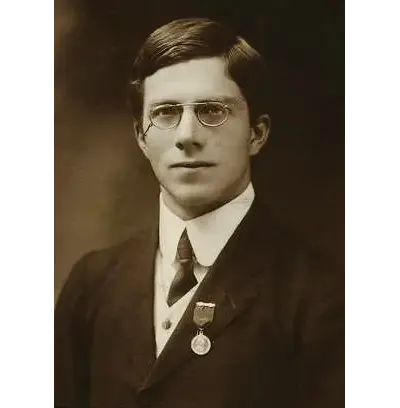
Sir Ronald Aylmer Fisher FRS was a British statistician, geneticist, and academic. For his work in statistics, he has been described as "a genius who almost single-handedly created the foundations for modern statistical science" and "the single most important figure in 20th century statistics". In genetics, his work used mathematics to combine Mendelian genetics and natural selection; this contributed to the revival of Darwinism in the early 20th-century revision of the theory of evolution known as the modern synthesis. For his contributions to biology, Fisher has been called "the greatest of Darwin’s successors".
