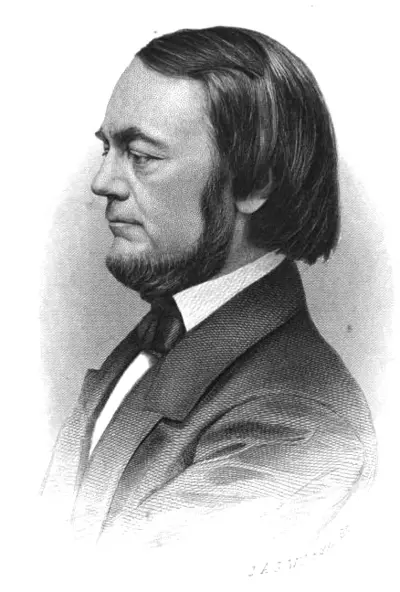
Edwin Percy Whipple Quotes
Do the adherents of this mad theory [Evolution] realize the disgrace they are bringing on the most respectable families! There is not an aristocracy in Europe or America that can stand it one moment. For aristocracy is based on the greatness of forefathers…. With a monkey in the background, how can even a Hapsburg or a Guelf put on airs of superiority? How must he hide his face in shame to think, that, as his line lengthens into an obscure antiquity, the foreheads of his house slope, and their jaws project; that he has literally been all his life aping aristocracy, instead of being the real thing; and that, when he has reached his true beginning, his only consolation must be found in the fact that his great skulking, hulking, gibbering baboon of an ancestor rejoices, like himself, in the possession of "the third lobe," "the posterior cornu of the lateral ventricle," and "the hippocampus minor.
Here we have a very mockery of the concept of aristocracy and “good family”. This humorous essay was written less than a decade after Darwin published his first treatise on evolution. Here a witty American essayist and critic is giving an insight into the thoughts of the many people who either were scandalized by the concept of human evolution or honestly could not grasp such a new intellectual set of concepts. Many of the great scientific intellectual breakthroughs spread with stunning rapidly—usually amongst scientists, but in the case of evolution to most intellectuals and men of letters, they could use Darwin’s framework and observe evidence of evolution all over. So here, less than 10 years from the inception of evolutionary theory among English scientist, we have American non-scientific literati reading articles in the general (albeit sophisticated) Atlantic Monthly with a semi-serious, semi-comical, analysis of the thinking of people who resisted what had become in just a few years obvious truth to America’s leading intellectuals (except for most of the leading intellectual theologians who would take longer to accept evolution, but, with the exception of the extreme fundamentalists, most did.
Edwin Percy Whipple, 1819-1886, Essayist & Critic, “Mr. Hardhack on the Derivation of Man from the Monkey”, The Atlantic Monthly, March 1867
Sourced by: Eigen's Political and Historical Quotations


At the time, there were many people who were outraged and offended by the Evolutionary concept that man descended from “brute” animals. Cummings was one of the people who went public against those conservative elements of society who had so much difficulty with the Theory of Evolution.


Actually no school teaches that. What they did teach when covering Evolution was that some modern apes (chimpanzees and bonobos) and humans were both descended from a common ancestor. The Congressman was at that point an evangelical Christian fundamentalist, Later, DeLay was convicted and sentenced to jail for money laundering and illegally spending and raising campaign funds. He was also reprimanded by the House Ethics Committee for unethical methods of fund raising for other earlier actions.


Bryan participated as a prosecutor in the infamous Scopes Trial in Tennessee where a school teacher was convicted of a crime for discussing the idea of evolution in a high school classroom. This view of opposition to Evolution was actually considered too liberal by many other Biblical Fundamentalists. They were just as distressed about the other animals as well as man. Evolution explicitly contradicted the literal story of Biblical creationism and therefore was blasphemy.


The idea that man’s ancestors were so called “lower animal” was very upsetting to many people. They did not necessarily have a religious objection to the idea but felt diminished somehow. Broca was one of those who tried to provide a more positive perspective.

This humorous essay was written less than a decade after Darwin published his first treatise on evolution. Here a witty American essayist and critic is giving an insight into the thoughts of the many people who either were scandalized by the concept of human evolution or honestly could not grasp such a new intellectual set of concepts. Many of the great scientific intellectual breakthroughs spread with stunning rapidly—usually amongst scientists, but in the case of evolution to most intellectuals and men of letters, they could use Darwin’s framework and observe evidence of evolution all over. So here, less than 10 years from the inception of evolutionary theory among English scientist, we have American non-scientific literati reading articles in the general (albeit sophisticated) Atlantic Monthly with a semi-serious, semi-comical, analysis of the thinking of people who resisted what had become in just a few years obvious truth to America’s leading intellectuals (except for most of the leading intellectual theologians who would take longer to accept evolution, but, with the exception of the extreme fundamentalists, most did.


Fisher, a brilliant scientist and mathematician, engaged in some major blunders like denying that tobacco had any relationship to lung cancer and other disease. This was another. His “conclusion” that the more “successful” members of society should breed in preference to the less successful. There are three major fallacies in his argument and that of other eugenics supporters other than the obvious ethical and moral problems. First, human success in any society is determined by both genetic and environmental factors. In general, it is currently impossible to know who the successful would be if environmental factors were equal. Second, our concept of success is quite narrow from an evolutionary point of view. The most successful humans might be those who produce that most children, or those who extend man’s habitat, or those who will be most resistant to a pandemic that will arise in the near future. Third, by the standards of much of English society at the time, the most “successful” people were the monarchy and heredity aristocracy, There was already too much inbreeding in these groups and increasing this groups breeding rather than others would not only weaken the species over time, but would limit the variation that is necessary for natural selection and further evolution of the human species.