Ibn Khaldun Quotes
When the [Abbasid] state was drowned in decadence and luxury... and overthrown by the heathen Tatars ... because the people of the faith had become deficient in energy and reluctant to rally in defense ... then it was God's benevolence that He rescued the faith by reviving its dying breath and restoring the unity of the Muslims in the Egyptian realms.... He did this by sending to the Muslims, from among this Turkish nation and its great and numerous tribes, rulers to defend them.
Abd al-Rahman Ibn Mohammad. He is generally regarded to be the World’s first social scientist. The largest statue in Tunisia of not of a military leader of king, but of this social scientist. The Arab view in the 14th century was that the Ottomans were a blessing from God—saviors rather than the occupiers as they were viewed by Arabs in the 20th Century.
Ibn Khaldun, 1332-1406, Tunisian Historian & Social Scientist, Description of the Turks coming to the Middle East and Ottoman rule there
Sourced by: Eigen's Political and Historical Quotations

Although the Turks were the enemy, the British when they “liberated” an area, turned to the local governors of the territory and asked them to “carry on,” supplying them with resources if necessary. This was just the opposite of the George W. Bush administration strategy in the Iraq War of 2004, where after taking Baghdad, all the old politicians and governors were arrested and the police and other infrastructure was removed. The replacements were inexperienced and had little respect and influence and the city fell apart. The moral hypocrisy of the British left the “bad guys” in place running things for them instead of the Turks. However, they were able to keep the cities running and keep control of the entire situation.


Ummah is the community of Muslims. There is historical reluctance to engage in civil war even if rulers are terrible. The unwillingness to depose the Taliban in Afghanistan or Sadam Hussein in Iraq is more comprehensible to those of the Islamic tradition than to Westerners who are more accustomed to and comfortable with revolutions, impeachments, and regime changes. Many Muslims feel that it is their religious duty to put up with a poor leader rather than bring instability and produce conflict amongst Muslims. The only exception is the case where the leader does not fulfill his religious obligations and follow the laws of God and the Prophet. This is great part explains the extreme efforts of dictatorial regimes like Saudi Arabia to support its religious establishment. As long as they do not offend the clerics, their regime is safe regardless of how undemocratic or how unfair. An-Nawawi was not just a Muslim scholar stating his own views, but he compiled his 40 Hadiths which are the views of the Prophet and carry great religious and cultural weight.

for a Muslim in a non-Islamic country Theological & Legal Expert. A fatwa is a religious legal ruling. This is an area of some controversy. Other Mufti’s Fatwas have taken the opposite view of non-participation.
Theological & Legal Expert. A fatwa is a religious legal ruling

Rebellion and revolution has always been unallowed in the Muslim religion.
This Sunnah of the Prophet is seen by many Shi’a Muslims as a call to renounce unjust governments and leaders. This is different from the view held by most Sunni Muslims that rulers are to be obeyed even if they are not always just. See {590245}.

Earl of Cromer

When the Turks defeated the Christians, the only explanation many Christians could conceive of was that God was on the side of the Turks.

After the 6 Day War, Israel was in control of the West Bank.
Pasha Muhammed Ali was the Ottoman Overlord of Egypt and Syria. He is an unusual example of a leader who was a realist relative to the skills and abilities of his family for succession. His family indeed could not hold Egypt.


The communal support of scholarship was common in the Middle East in both Muslim and Jewish communities.

After the King’s appointment in 1921 she “advised” him on establishing this regime and operating the government. At a time that women could not even vote in England, Bell was a kingmaker and major power in an area of the world that was much more sexist than England at the time.

This Arab nationalist leader was actually a Christian Orthodox by religion. He also tried to make the Baath party a secular state and he was a strong advocate of free speech and democracy. When the Islamic fundamentalists became important in Mid East Politics, the Baath Iraq Government under Saddam Hussein claimed, with no evidence, that Aflaq converted to Islam on his deathbed, thus making his philosophy more acceptable to the vast majority of Arabs.

This quotation is interesting for two reasons. First, it is one of the few fatwas that recognize women to make a decision that might be against her husband’s wishes—a rarity in Islam which is even more sexist than traditional Western religions. Second, and more important, this fatwa is often used by Muslim fundamentalist terrorists to justify the use of women as suicide bombers. Even with a modern Islamist like al-Qaradawi, the obligation to defend with life if necessary any Muslim nation (right or wrong) is paramount and justifies almost anything else that otherwise might not be permitted. This is very different from most of the rest of the world where national interests are rarely perceived as religious and most attacks on a country have nothing to do with religion but with vested interests.
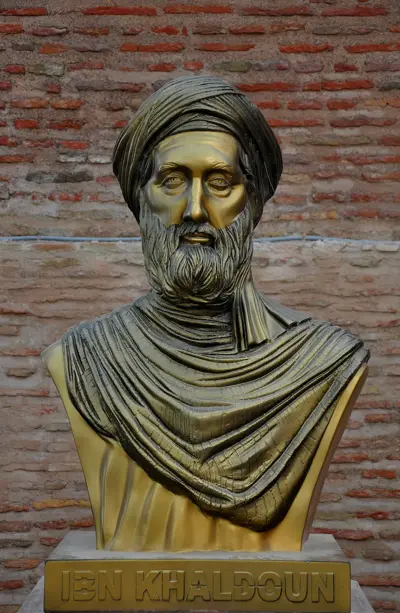
Ibn Khaldun was an Arab sociologist, philosopher and historian who has been described as the founder of the modern disciplines of historiography, sociology, economics, and demography. Niccolò Machiavelli of the Renaissance and the 19th-century European scholars widely acknowledged the significance of his works and considered Ibn Khaldun to be one of the greatest philosophers of the Middle Ages.
