Hideki Tojo Quotes
When reflecting upon it today, that the Pearl Harbor attack should have succeeded in achieving surprise seems a blessing from Heaven. It was clear that a great American fleet had been concentrated in Pearl Harbor, and we supposed that the state of alert would be very high.
Hideki Tojo, 1884-1948, Japanese General & Prime Minister, Entry in His Prison Diary
Sourced by: Eigen's Political and Historical Quotations


He was describing a meeting that he and General Marshall had conducted with FDR, Secretary of State Cordell Hull and others. In less than two weeks, the Japanese would attack Pearl Harbor without any declaration of war, as Marshall had predicted.


In 1930, Japan, Britain, and the United States had signed an agreement that submarines would not sink merchant vessels without having first placed passengers and crew in a place of safety. However, when Japan attacked Pearl Harbor and bombed civilians as well as military and had a pattern of bombing and shelling civilians in China, the U. S. took the position that Japan had abrogated all treaties and therefore abrogated the 1930 treaty. It was more of a symbolic gesture as at the time the American forces were in no shape to attack Japanese merchant shipping though later in the war, it became material. By that time, the Japanese had murdered American prisoners of war on the Bataan Death March and elsewhere and had slaughtered civilians in the Philippines and all the other territories that they invaded. The niceties of the 1930 treaty was one of the first casualties of Japanese aggression.


Some claim that the attack on Pearl Harbor and the Japanese aggression of WWII was the doing of the military clique that had dominated the government. This quotation shows that there was much enthusiasm by the traditional civilian politicians as well.
After the sneak attack on Pearl Harbor, Stimson drafted the Declaration of War that President Roosevelt would ask Congress to vote for. However, there was a small but very vocal group of extreme Republican conservatives who opposed assisting England against Hitler and saw German and Italian Fascism as positive forces. They would oppose any administration declaration of war against Germany and Italy who had not yet attacked any American facilities. The President realized that German and Italy had a Mutual Defense Treaty with Japan, and when we declared war against Japan, would have to ally with Japan or reneg on their treaty. So FDR removed Germany and Italy from the Declaration and Congress just declared war against Germany. In the next days, Germany and Italy declared war against the United States, and the de facto situation was as Stimson had drafted it, but FDR had not given the right wing American Fascist sympathizers any issue to criticize the administration.
Yamamoto planned and commanded the Japanese attack on Pearl Harbor. However, he thought that the Japanese Declaration of War would be delivered in Washington before the attack as was required then by the international rules of war. The Japanese Government however did not deliver the war declaration until after the attack. Yamamoto was not only distressed about the non delivery but was concerned that the “sneak attack” was going to motivate the Americans to an all out war, when the Japanese strategy had been to negotiate a rapid peace giving them more freedom of action in the Pacific. Yamamoto was right. “Remember Pearl Harbor” became the rallying cry, and America would accept no peace other than Japanese Unconditional Surrender.

Marshall was chief of staff of the army at that time. His projection essentially turned out to be true. However, even he underestimated the Japanese who got all the way to Pearl Harbor and attacked before they were detected. Marshall had advocated placing long range heavy bombers in Hawaii that could perform long range scouting missions. Congress would not make the funds available.
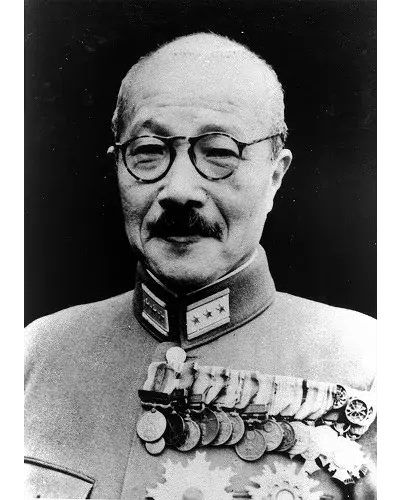
Hideki Tojo was a Japanese politician and general of the Imperial Japanese Army (IJA) who served as Prime Minister of Japan and President of the Imperial Rule Assistance Association for most of World War II. During his years in power, he assumed several more positions including Chief of Staff of the Imperial Army before ultimately being removed in July 1944.
