George C. Marshall Quotes
It is possible that our opponents in the Pacific would be four-fifths of the way to Hawaii before we knew that they had moved...
Marshall was chief of staff of the army at that time. His projection essentially turned out to be true. However, even he underestimated the Japanese who got all the way to Pearl Harbor and attacked before they were detected. Marshall had advocated placing long range heavy bombers in Hawaii that could perform long range scouting missions. Congress would not make the funds available.
George C. Marshall, 1880-1959, General & U. S. Army Chief of Staff, U. S. Secretary of State, U. S. Secretary of Defense, Nobel Peace Prize Winner (The only soldier ever so honored), Statement at Staff Meeting, June 17, 1940
Sourced by: Eigen's Political and Historical Quotations


Plan Orange was the code name of the united states plan for possible war with Japan. In this ironic quotation, American military planners realized five years before Pearl Harbor that surprise attack was the major vulnerability. We were surprised and had no help from our intelligence service which despite the recommendations was almost nonexistent.


One difficulty of diplomacy with many Islamic leaders is that the culture produces very aggressive rhetoric and very aggressive actions like Islamic terrorism. This quotation is often cited to demonstrate that it is the Iranians that had decided that America is it’s enemy; that America is to be humbled; and that their weapons development are targeted at America. This along with the most frequent Iranian slogan, “Death to America,” for many argues for preemptive military action or maintenance of a high state of readiness. Given statements like this from the leading soldier of the theocracy, there is little doubt that Iranian nuclear weapons would be a great danger to America. Therefore when Iran complains that America did not object to the fact that other nations have the nuclear bomb, they do not take their own rhetoric into account. No other nation with possible nuclear capability has made America its major military adversity and claims as an objective to humble the United States.

If we replace the word “socialist” with “capitalist” this statement would be approved by almost every American Senior Military officer and Defense Official as well as most members of Congress. The reality was that the basic defense posture of the Soviet Union and the United States was essentially the same during the Cold War.

This historical quotation is important for two reasons, First, it shows us that the concept of a Canal was discussed fully a decade before Theodore Roosevelt actually had it built. Second, there were those who feared that a canal would actually be a detriment to the United States as our Navy was then quite weak. TR however built up the navy and made a great world-wide show of it and also built the Panama Canal.

In retrospect Marshall was prescient and if his advice had been followed, the country would have been much better off at the beginning of WWII. The nation was isolated politically and militarily with Republicans and southern Democrats often opposing President Roosevelt’s attempts to help them defend themselves. There was of yet no political will for military preparedness.


For most of the history of the United States – especially in the governments of our Founding Fathers, there was an extreme antithesis to defense spending and military preparedness a fact that conservatives who look to the Founding Fathers as models and legal precedents for everything that we do today generally do not realize as they lobby for defense spending. The change really took place after Pearl Harbor and WWII where America was totally unprepared for war.

There is a , romantic American myth about the Militiamen in Colonial and Revolutionary America—the citizen soldiers who would leave their farms and rise to the military necessity of the day. However, not only were the militia very hard to muster to duty, but most actually didn’t own or have experience with firearms, and the prevailing opinion of knowledgeable military leaders from George Washington on down was that the militia were not very good soldiers. See {613015}, {613016}, {613022}, {613027}, {621987}, {621988}, {613030}, {613033}, & {613056}


Gingrich, who avoided serving in the military throughout his life, was frequently opining on military matters, tactics and strategy in his speeches, media appearances and many writings. Generally, he was a Chicken Hawk {625110} urging military action and war although he had personally never experienced it. He spent much time in military meetings and conferences, and thought that he had developed some expertise from this and his extensive reading.

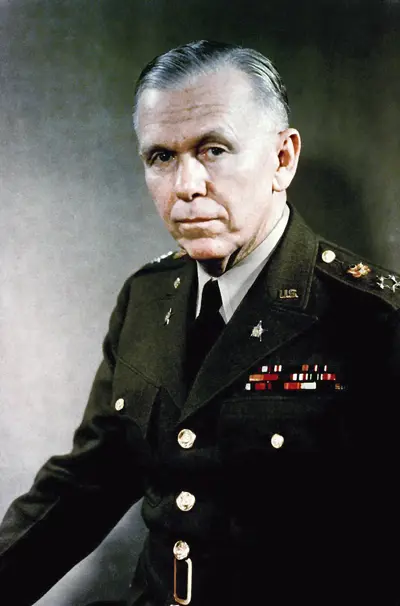
George Catlett Marshall Jr. was an American soldier and statesman. He rose through the United States Army to become Chief of Staff under presidents Franklin D. Roosevelt and Harry S. Truman, then served as Secretary of State and Secretary of Defense under Truman. Winston Churchill lauded Marshall as the "organizer of victory" for his leadership of the Allied victory in World War II. After the war, he spent a frustrating year trying and failing to avoid the impending civil war in China. As Secretary of State, Marshall advocated a U.S. economic and political commitment to post-war European recovery, including the Marshall Plan that bore his name. In recognition of this work, he was awarded the Nobel Peace Prize in 1953.
