George C. Marshall Quotes
Continuous paring of appropriations has reduced the Army virtually to the status of that of a third-rate power
Marshall was then the chief of staff of the army.
George C. Marshall, 1880-1959, General & U. S. Army Chief of Staff, U. S. Secretary of State, U. S. Secretary of Defense, Nobel Peace Prize Winner (The only soldier ever so honored), Biennial Report of the Chief of Staff of the United States Army, July 1, 1939, to June 30, 1941, to the Secretary of War
Sourced by: Eigen's Political and Historical Quotations


This was an official publication of the U. S. Army. The First World War had very little affect on future military preparedness At that time conservatives in Congress were very isolationist and military preparedness was not a high priority or even a significant political issue. The Democrats then were more supportive of military spending than the Republicans. It took World War II, for which America was very unprepared, to produce a change in public and political opinion regarding military preparedness.


For most of the history of the United States – especially in the governments of our Founding Fathers, there was an extreme antithesis to defense spending and military preparedness a fact that conservatives who look to the Founding Fathers as models and legal precedents for everything that we do today generally do not realize as they lobby for defense spending. The change really took place after Pearl Harbor and WWII where America was totally unprepared for war.

In early America, there was great concern about a standing army—a military force that exists and is organized in peacetime. History showed the founding fathers that tyrants who siezed power almost always did so by getting control of the standing army. The logic was if there is no standing army, no one can control it and therefore no tyrant can control the country by force. At the time, however, with oceans protecting us, there was penty of time to mobilize a defensive army should any foreign power invade. However, with modern military technology, and the importantance of retaliation as a protective3 strategy, it is virtually impossible to not have a standing army and stoll be secure.


Political disputes over the degree of defense spending are classic in American political history. In the early 20th century, most conservatives were opposed to government spending for the military and the President had great difficulty getting the Conservative wing of his own party to support increased military appropriations. The remains of the great naval hero John Paul Jones had just been brought to the United States from France in which he had died. A large ceremony was held in Annapolis, Maryland and most of the conservatives who had opposed the military spending proposed by Roosevelt attended the ceremony to demonstrate their patriotism. TR shocked them by turning the solemn ceremony into a political embarrassment for them.


Washington, although the presiding officer of the Constitutional Convention, said almost nothing for such was the respect for him that he cou;d sway almost any issue. But the absurdity of limiting the size of the American Army was too much for him, and his clever way of phrasing his concern ended discussion of that idea without any ill feelings.


The Congress wants to keep control of exactly what the Pentagon buys so that each member can try to get more than his fair share of the Federal dollar. But the Congressional budget process is usually slow, and with the recent Congresses they can hardly get anything done. The President nor the Secretary of Defense cannot stop or slow down procurements that are not needed or can be deferred and spend the already appropriated funds on emergency needs for the troops fighting in the field.
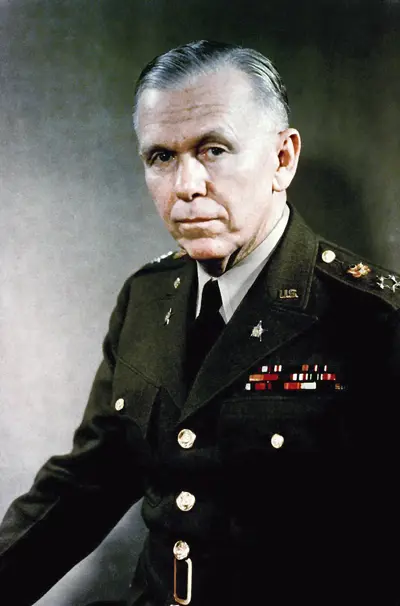
George Catlett Marshall Jr. was an American soldier and statesman. He rose through the United States Army to become Chief of Staff under presidents Franklin D. Roosevelt and Harry S. Truman, then served as Secretary of State and Secretary of Defense under Truman. Winston Churchill lauded Marshall as the "organizer of victory" for his leadership of the Allied victory in World War II. After the war, he spent a frustrating year trying and failing to avoid the impending civil war in China. As Secretary of State, Marshall advocated a U.S. economic and political commitment to post-war European recovery, including the Marshall Plan that bore his name. In recognition of this work, he was awarded the Nobel Peace Prize in 1953.
