Ron Paul Quotes
Sometimes Republicans want to cut the social welfare programs and yet they ask for billions and billions more for the Defense Department. I don’t take that approach.
Ronald E. Paul, U.S. Congressman (Republican, TX), Libertarian Nominee for President, PBS The Charlie Rose Show, September 18, 2013
Sourced by: Eigen's Political and Historical Quotations


Most Republicans at the time would argue for government spending reductions except for defense spending for which they wanted an increase in most cases despite huge waste and abuse in the Department of Defense. (See {615006} for just one example). Mulvaney, a new congressman with Tea Party backing, pointed out the hypocrisy of the this Republican position over the last decades, but this had been a central part of the Ronald Reagan platform.


At the time there were tax breaks for large yachts but not for small boats that a middle class person might own. It was another example of the tax laws at the time where the poor paid only Social Security taxes, and the rich lobbied for an got very large tax breaks and subsidies and hence the burden was carried by an increasingly stressed middle class .and by cuts in services to the needy. The companies that made the yachts also supported the tax breaks as did the unions and workers in the industry. . See {624984}. .
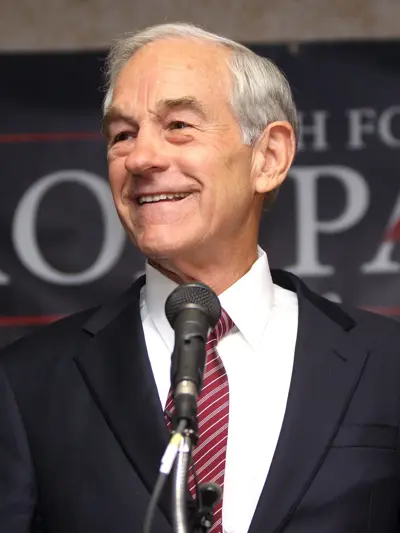
Ronald Ernest Paul is an American author, physician, and retired politician who served as the U.S. Representative for Texas's 22nd congressional district from 1976 to 1977 and again from 1979 to 1985, and for Texas's 14th congressional district from 1997 to 2013. On three occasions, he sought the presidency of the United States: as the Libertarian Party nominee in 1988 and as a candidate for the Republican Party in 2008 and 2012. A self-described constitutionalist, Paul is a critic of the federal government's fiscal policies, especially the existence of the Federal Reserve and the tax policy, as well as the military–industrial complex, the war on drugs, and the war on terror. He has also been a vocal critic of mass surveillance policies such as the USA PATRIOT Act and the NSA surveillance programs. He was the first chairman of the conservative PAC Citizens for a Sound Economy, a free-market group focused on limited government, and has been characterized as the "intellectual godfather" of the Tea Party movement, a fiscally conservative political movement that is largely against most matters of interventionism.
