Robert D. Kaplan Quotes
When the economies of countries grow, their militaries generally do as well.
Robert D. Kaplan, Political Writer, Interview, WAMU The Diane Rehm Show, September 5, 2007
Sourced by: Eigen's Political and Historical Quotations


In early America, there was great concern about a standing army—a military force that exists and is organized in peacetime. History showed the founding fathers that tyrants who siezed power almost always did so by getting control of the standing army. The logic was if there is no standing army, no one can control it and therefore no tyrant can control the country by force. At the time, however, with oceans protecting us, there was penty of time to mobilize a defensive army should any foreign power invade. However, with modern military technology, and the importantance of retaliation as a protective3 strategy, it is virtually impossible to not have a standing army and stoll be secure.


The Progressive article was an interview with Movie Director and Screenwriter Oliver Stone who told the interviewer that he had learned of this quotation when he did his research for his film, South of the Border where he had several interviews with President Kirchner.


Japan was a militarist aggressive state when they started WWII in the Pacific. Their military brutalized China and almost every other country in Asia committing atrocities that those nations still are bitter about today. The unconditional surrender required that their new Constitution prohibit a military. However some of the Conservatives like Abe do not believe that Japan should be the only nation denied a military. Most of the rest of Asia even resents and fears the defense forces that they have and would seriously oppose a reestablishment of a military.


This was an official publication of the U. S. Army. The First World War had very little affect on future military preparedness At that time conservatives in Congress were very isolationist and military preparedness was not a high priority or even a significant political issue. The Democrats then were more supportive of military spending than the Republicans. It took World War II, for which America was very unprepared, to produce a change in public and political opinion regarding military preparedness.


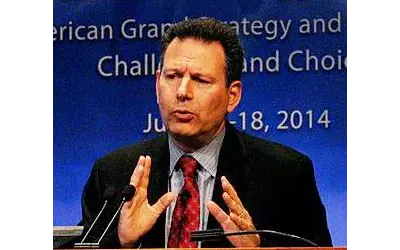
Robert David Kaplan is an American author. His books are on politics, primarily foreign affairs, and travel. His work over three decades has appeared in The Atlantic, The Washington Post, The New York Times, The New Republic, The National Interest, Foreign Affairs and The Wall Street Journal, among other newspapers and publications.
