Marie Curie Quotes
When one studies strongly radioactive substances special precautions must be taken if one wishes to be able to take delicate measurements. The various objects used in a chemical laboratory and those used in a chemical laboratory, and those which serve for experiments in physics, become radioactive in a short time and act upon photographic plates through black paper. Dust, the air of the room, and one's clothes all become radioactive.
Curie, Marie. Radio-Active Substances. 2nd ed., Chemical News Office, 1904, p. 86.


Within a few months 11,021 scientists, of forty-nine countries also signed the appeal.


This was a political use of sarcasm and irony. Oak Ridge was the site of the largest facility for producing fissionable material in the world as the result of the Manhattan Project. And yet the problem of what to do with the radioactive waste has never been resolved. So Oak Ridge was producing more and more radioactive uranium in the area without a resolution in sight. The “joke” was that the people in the area were immune, so production could continue without a solution to radioactive waste.


While this sounds like an idiotic statement, at the time very little was known by anyone about the effects of large doses of radiation. Groves had not then the benefit of the medical reports or interviews about the Japanese who had received high doses of radiation from the 2 atomic bomb attacks.


This was the first description of Radioactive Decay.

Rocky Flats was operated for the government by Dow Chemical Company, which unfortunately violated the terms of their contract and improperly buried nuclear waste which ended up producing so much radiation that the plant had to be closed down and the government had to buy up property around the nuclear plant as a buffer zones so that private people would not receive high radiation doses by being too close to the plant.

The First Lady was very practical. Although she was a strong advocate of women working in all areas of the labor force, she also realized that there were very few women who had done so before and thus there were few role models for them. So women did not generally know how to dress to keep themselves safe. And if she thought any information was needed, she used her daily syndicated column in many of America’s newspapers to convey that information.


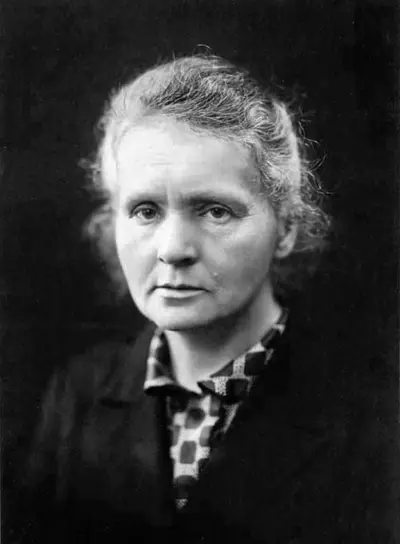
Marie Skłodowska Curie (/ˈkjʊəri/ KEWR-ee; French: [kyʁi]; Polish: [kʲiˈri]), born Maria Salomea Skłodowska, was a Polish and naturalized-French physicist and chemist who conducted pioneering research on radioactivity. As the first of the Curie family legacy of five Nobel Prizes, she was the first woman to win a Nobel Prize, the first and the only woman to win the Nobel Prize twice, and the only person to win the Nobel Prize in two scientific fields. She was the first woman to become a professor at the University of Paris in 1906.
