Dick Gephardt Quotes
When I'm president, we'll have executive orders to overcome any wrong thing the Supreme Court does tomorrow or any other day
Gephardt, Richard. Remarks at the NARAL Pro-Choice America Dinner. Washington, D.C., 21 Jan. 2003. Quoted in The Washington Post, 23 Jan. 2003, p. A4.


President George W. Bush had ignored a federal law and tapped the phones of Americans without probable cause and a warrant issued by a court. The President’s defenders argued that the President, as Commander in Chief, has the Constitutional responsibility to lead the military and protect the nation. Intelligence gathering is part of military activity. Therefore the intelligence gathering is a Constitutional duty and the Congress, under the separation of powers doctrine, may not interfere with the President’s Constitutional Duty to conduct intelligence. Under this doctrine, the President need not obey laws that he believes impinge on his management of the war effort and the defense of the nation. Most legal scholars believe that this argument is nonsense, but the George W. Bush administration has stated the doctrine and it was the subject of much litigation.


Barstow the Democratic Governor who had no serious opposition in 1853 found himself challenged for reelection by Coles Bashford of the new Republican Party. The Board of Canvassers reported that Governor Barstow had won reelection but by less than 200 votes in the whole state. The Republicans charged that there had been fraud in some of the rural districts and petitioned the Wisconsin Supreme Court which ruled that nonexistent precincts had indeed voted for the Governor. The Barstow however refused to recognize the decisions of the court claiming that the court had no jurisdiction over the Board of Canvassers who were part of the executive branch. The Republicans held their own inauguration and two men claimed to be Governor. But the Governor claimed that the state constitution did not give the court any authority to deal with the crisis, He even called out the State Militia to maintain his office and intimidate the Supreme Court and keep the “other governor” from the state house. Nonetheless the court ruled that even the Governor had to obey the law and the Supreme Court would determine what the law was. Barstow finally “resigned.” See {587917} & {587914}.

The President had authorized the NSA to spy Americans who might have been suspected of being themselves or being in contact with terrorists without obtaining permission of a court including the Foreign Intelligence Surveillance Act (FISA) special court that had been established for these cases. Instead the administration argues that it was inherent in the powers of the Presidency in time of war.


When the Senate was debating the Gulf of Tonkin Resolution, which would empower the President to take "all necessary measures" to repel any armed attack on U. S. forces, Senator Morse was one of only two Senators opposing the resolution:

The Roosevelt administration had stemmed the tide of Hoover’s Great Depression but the nation had not yet recovered. The New Deal measures, most of which would be considered fundamental to good government 50 years later was being constantly thwarted by a Supreme Court with a strong arch conservative majority headed by James McReynolds, a virulent, overt, anti-Semitic racist, who hated FDR—see {616652} and {585241}. The situation was to many like that which existed before the Civil War when the Court rendered the Dred Scott decision that so harmed the nation. Frankfurter, not then a Supreme Court Justice, urged Roosevelt to do something lest the American Public lose all respect for the Court and our Constitutional system and have the nation harmed by not allowing reforms like child labor laws to go through. The court actually ruled by a narrow majority that the government could not pass laws making it illegal for 11 year old children to work in coal mines or factories. FDR attempted to add more justices turning the majority into a majority—“packing the Supreme Court”, but that politically backfired. Some of the reforms never went through while others needed Constitutional Amendments like the end to Prohibition.

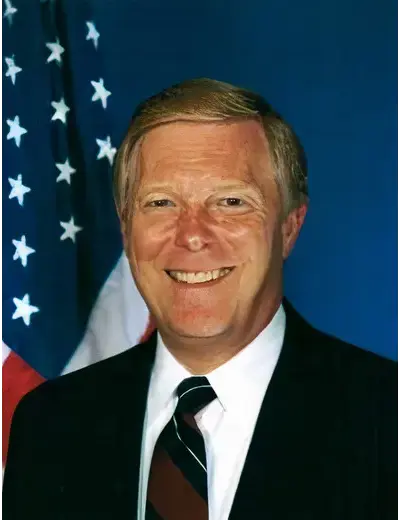
Richard Andrew Gephardt is an American politician who served as a United States Representative from Missouri from 1977 to 2005. A member of the Democratic Party, he was House Majority Leader from 1989 to 1995 and Minority Leader from 1995 to 2003. He ran unsuccessfully for the Democratic nomination for President of the United States in 1988 and 2004. Gephardt was mentioned as a possible vice presidential nominee in 1988, 1992, 2000, 2004, and 2008.
