Andre Gide Quotes
When everything belongs to everyone, nobody will take care of anything.
Gide, André. Return from the U.S.S.R. Translated by Dorothy Bussy, Alfred A. Knopf, 1937, p. 31.


Alexander Dubcek, Communist leader of Czechoslovakia, had pushed reform so far that 5 Soviet armies invaded. Dubcek was brought to Russia where he tried to persuade the Russian premier that the invasion was contrary to the principles of socialism.


Theoretically, this decree would have provided a fair amount of economic freedom for communist Russia. This decree gave some degree of comfort to the Western Europe and America, but had some major opponents within world communism who thought it too capitalistic. In practice the rights were never really available and this was one of the many “principles” of Soviet Communism which may have sounded reasonable but were never allowed to function in practice. Within a few years even the pretense of these principles was dropped.
This was the basic document issued after the Russian Revolution establishing the basic legal and economic structure of the new Soviet State.

Samuel Langhorne Clemens, 1835-1910. Ironically, during the McCarthy period and the Red Scare of the 1950s, some of the right wingers charged that Mark Twain’s writing was “Communist Propaganda”. Most of the accusers had never read most of Train’s work. At the time, the Communists had condemned the racial segregation that was then legal in America and most of the staunch Southern segregationists accused anyone who attacked segregation as a communist. Twain was one of the leading voices against American racism. As for communism, the accusers of Train had probably never read this particular quotation. Twain was an early severe critic of communism and used his favorite weapon—humor—to attack it.


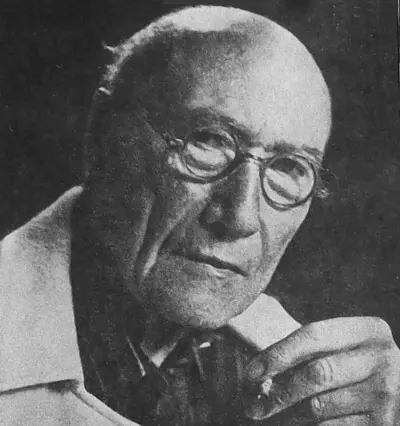
André Paul Guillaume Gide was a French author and winner of the Nobel Prize in Literature (in 1947). Gide's career ranged from its beginnings in the symbolist movement, to the advent of anticolonialism between the two World Wars. The author of more than fifty books, at the time of his death his obituary in The New York Times described him as "France's greatest contemporary man of letters" and "judged the greatest French writer of this century by the literary cognoscenti."
