Mark Twain Quotes
Communism is idiocy. They want to divide up the property. Suppose they did it -- it requires brains to keep money as well as make it. In a precious little while the money would be back in the former owner's hands and the communist would be poor again.
Samuel Langhorne Clemens, 1835-1910. Ironically, during the McCarthy period and the Red Scare of the 1950s, some of the right wingers charged that Mark Twain’s writing was “Communist Propaganda”. Most of the accusers had never read most of Train’s work. At the time, the Communists had condemned the racial segregation that was then legal in America and most of the staunch Southern segregationists accused anyone who attacked segregation as a communist. Twain was one of the leading voices against American racism. As for communism, the accusers of Train had probably never read this particular quotation. Twain was an early severe critic of communism and used his favorite weapon—humor—to attack it.
Mark Twain, Writer, Founder, Anti-Imperialist League, Mark Twain, a Biography
Sourced by: Eigen's Political and Historical Quotations

He was a strong foe of both Communism and Capitalism. He was one of the first critics to describe the de facto inequality of Communism.


Ataturk was not receptive toward Communism as some other world leaders were at the time. He saw its weakness far earlier than many others.


The major problem at the time was not the capitalist in the industrial revolutionary sense of the word as there was little industry. China as an agrarian society but the vast majority of the land was owned by relatively few wealthy families. It was close to a feudal system and that was the target for the Communists and their revolution. There was a very small proletariat. Their methods were brutal, but they executed the landlords and the class warfare ended quickly. Sun Yat-sen was not able to solve the land problem, nor was Chiang Kai-shek as most of his major supporters were landowners of warlords who controlled the landowners.

Unlike most of his televangelist successors, Sheen was very ecumenical. He was clearly Catholic but had a very significant Protestant and Jewish Audience.


This line was a takeoff on the famous quotation of Karl Marx: {624064}.


Socialism in its then pure form had the state owning and controlling all the major assets of the nation. In this sense it was contradictory to individual freedom and hence democracy. However, in the years after Tocqueville’s quotation and the industrial revolution, socialism has gradually moved away from state ownership and operations of all institutions and resources. Democracy has tended to adopt a more regulatory view to control the excesses of unbridled capitalism. The range of democratic nations by the 21st century encompassed differences but some were described as “social democracies” and had some state ownership but were basically capitalistic economies. Even the self-described Communist nations had become heavily capitalistic albeit with less political freedom. At the same time, even the United States—the epitome of 21st century capitalism, owned and controlled a few of the resources and means of production and tended to regulate the others—a substantial difference from the American democracy which Tocqueville studied.


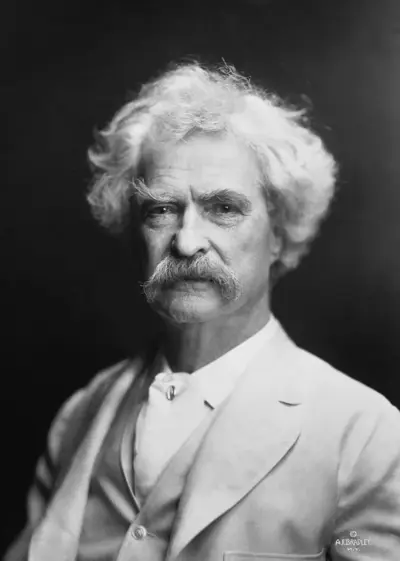
Samuel Langhorne Clemens, known by his pen name Mark Twain, was an American writer, humorist, entrepreneur, publisher, and lecturer. He was lauded as the "greatest humorist the United States has produced," and William Faulkner called him "the father of American literature". His novels include The Adventures of Tom Sawyer (1876) and its sequel, the Adventures of Huckleberry Finn (1884), the latter often called "The Great American Novel".
