Margaret Thatcher Quotes
If a Tory does not believe that private property is one of the main bulwarks of individual freedom, then he had better become a socialist and have done with it.
Margaret Thatcher, 1925-2013, British Prime Minister (Conservative), "My Kind of Tory Party", Daily Telegraph, January 30, 1975
Sourced by: Eigen's Political and Historical Quotations


Alexander Dubcek, Communist leader of Czechoslovakia, had pushed reform so far that 5 Soviet armies invaded. Dubcek was brought to Russia where he tried to persuade the Russian premier that the invasion was contrary to the principles of socialism.


Many people had come to the conclusion that capitalism as it then existed was not sufficient to correct some of the serious inequities in society. They saw that socialism tended more to focus on those. However, they also saw in socialism per se, as it was than advocated, many other problems. Steffens seems to be the first person to describe that type of person, in this case, himself.


Randolph Churchill was recalling how Bracken had once attacked Aneurin Bevan for being a “champagne socialist.”

Socialism in its then pure form had the state owning and controlling all the major assets of the nation. In this sense it was contradictory to individual freedom and hence democracy. However, in the years after Tocqueville’s quotation and the industrial revolution, socialism has gradually moved away from state ownership and operations of all institutions and resources. Democracy has tended to adopt a more regulatory view to control the excesses of unbridled capitalism. The range of democratic nations by the 21st century encompassed differences but some were described as “social democracies” and had some state ownership but were basically capitalistic economies. Even the self-described Communist nations had become heavily capitalistic albeit with less political freedom. At the same time, even the United States—the epitome of 21st century capitalism, owned and controlled a few of the resources and means of production and tended to regulate the others—a substantial difference from the American democracy which Tocqueville studied.

While generally true, Mises here again exaggerates his “proof” by selectively ignoring or being ignorant of counter-examples. The Roman Catholic Church is a classic counter-example where priests, monks, and others owned nothing as individuals, but produced some great science (eg Gregor Mendel), art (the illuminated texts of the middle ages), literature (St Thomas Aquinas, etc). The best counter example that was just evident in the last decade of Misis’ life is Communist Russia. Russian science was better than Fance and Germany and second only to the United States. The Russian ballet and orchestras were second to none. Great literature came out of the Soviet Union and the best of it complained about and attacked the Soviet system of the times. In general, Mises principle tended to be correct throughout history but not always as he dogmatically stated.

3rd Earl Russell of Kingston. He favored and argued for a middle ground of a capitalistic socialism or a socialized capitalism, which is what most democracies became.
3rd Earl Russell of Kingston. Ironically he was regarded as a socialist by most people. His view of socialism however was what evolved as European Democratic Socialism and not the “dictatorship or the proletariat” type of Communist Socialism.

She was proposing s radically different pattern of work and economic structure--one of the few really original ideas. All Americans between 18-26 years of age would serve the nation and be assigned to producing and providing the necessities of life for all of society.—Food, Shelter, Health Care etc, See Quotation 644625 for more details,


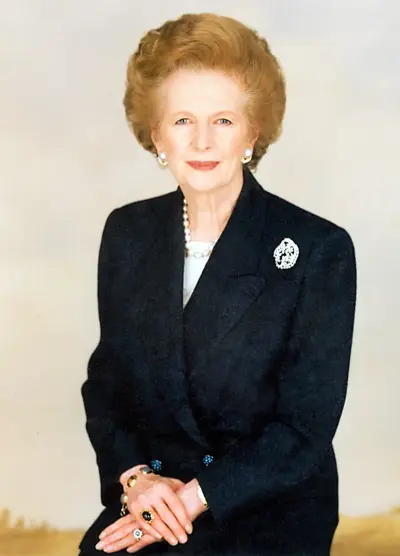
Margaret Hilda Thatcher, Baroness Thatcher, LG, OM, DStJ, PC, FRS, HonFRSC was a British stateswoman who served as Prime Minister of the United Kingdom from 1979 to 1990 and Leader of the Conservative Party from 1975 to 1990. She was the longest-serving British prime minister of the 20th century and the first woman to hold that office. A Soviet journalist dubbed her the "Iron Lady", a nickname that became associated with her uncompromising politics and leadership style. As prime minister, she implemented policies that became known as Thatcherism.
