Joseph McKenna Quotes
What constitutes a cruel and unusual punishment has not been exactly decided. It has been said that ordinarily the terms imply something inhuman and barbarous.
Joseph McKenna, 1843-1926, U. S. Supreme Court Justice, Weems v. United States, 1909
Sourced by: Eigen's Political and Historical Quotations

The capital punishment debate was raging in Europe. Belgium and parts of Switzerland had just abolished the death penalty.


Named after penal reformer Johne Howard, 1726-1790. Howard Associations have since been organized in many countries.

It is surprising that these ideas would come from one of the most autocratic powerful monarch in the world at the time. However there were many very liberal influences on her from Europe. This set of proposals she even sent to Voltaire to get his feedback and criticism. As late as 2006 the American President was reluctant to outlaw torture for terroristsand the Vice President actually argued for its retention as an interrogation technique. Over 300 years earlier the autocrat of Russia argued against it.

Einstein had changed his mind. He like almost everyone else at the time favored the death penalty, but in 1927 came to the new conclusion for the same reasons that many American politicians stated 70 years later. He had no compunctions against capital punishment for murderers who were dangers to society, but the potential error of the justice system led him to oppose state sanctioned execution. At the time the number of errors in capital cases that had been demonstrated were few. But as a scientist, Einstein knew that all human endeavors were prone to error. He was a strong law and order supporter however—see {588606}.


This quotation while difficult for us to fathom today, illustrates a very conservative 18th century view of punishment and law enforcement. The South African high court was very distressed that torture was to be ended. To them, and many others throughout the so called “civilized” European cultures of the time, capital punishment was not a very good deterrent—even for slaves. The execution was usually accompanied by horrible torture and cruelty before death. Slavery was such a horrible life, and the White colonists knew it, that death could be welcome (many slaves had committed suicide). So the suffering at the execution was to serve as a further deterrent. In reality it did not, any more than capital punishment did in the 20th century, but by the logic of the culture and the times, torture was needed as well as capital punishment.


England, and most other countries of Europe, had put people who could not pay their debts in prison. When our founding fathers formed the constitution, they too saw debtors’ prison as an acceptable concept. 11 years earlier Congress had outlawed Federal Debtors’ Prisons. However many states and local governments then still had them. Smith wanted them abolished completely. What is fascinating about this quotation is that although the head of a religion, Smith was not advocating the kinds of personal lifestyle issues of his church the way modern religious leaders do, but was concerned with the much larger issues of expansionism, corruption of the courts and judiciary, and land distribution. He was a classic reform candidate in that sense. Smith had written to most of the then likely Presidential candidates of both major parties asking for their position on the Mormons who were facing persecution wherever they went. None of the politicians would make any satisfactory commitments. Smith took Direct Action and became the only major religious official to have run for the Presidency of the United States until Pat Robertson tried and failed in 2000. Smith’s assassination shortly thereafter cut his run for the Presidency short before it made much headway and politically he had no chance to affect the race.


Queen Boudicca of the Iceni tribe had revolted in Roman Britain. The Romans where particularly harsh in putting down revolts but under Emperor Nero and Caligula after him, they sunk to the deepest of barbarities,


At the time, the dependence on Saudi oil inhibited American criticism . This began to change in the 21st century.

William the Conqueror. This is one of the first if not the first nationwide abolition of capital punishment in history. Ironically, the two alternatives that the abolition law allowed would both be illegal and repugnant to us today even though we allow capital punishment.

This is one of the several examples of Biblical injuntions to burn transgressors at the stake. See Related Quotes for others. Both New and Old Testamant not only did not condemn this cruelty, but actually proscribed it. This was one of the reasons that it was so difficult for Christian nations to abolish the practice. Not also the patriarchial nature of the rationale for such a punishment. It was not what the daughter did per se that was the offence. It was the the dishonor and profanity of the father that was the crime that had to be punished, Also, priest's daughters were treated more severly than other daughters.


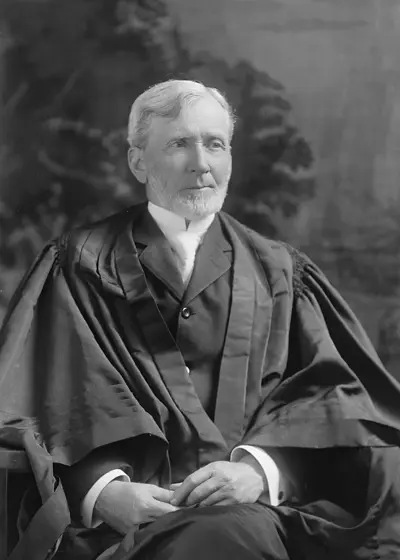
Joseph McKenna was an American politician who served in all three branches of the U.S. federal government, as a member of the U.S. House of Representatives, as U.S. Attorney General and as an Associate Justice of the Supreme Court. He is one of seventeen members of the House of Representatives who subsequently served on the Supreme Court (including two Chief Justices).
