Robert McNamara Quotes

He had just digested his predecessor’s reports and briefings as well as key interviews with senior military officers. See {637677} for his predecessor’s statement in the previous White House meeting on the War.

Early in the year the President asked his most experienced political strategist what was likely to happen in the Presidential election that was upcoming later that year. The Vietnam War was tearing the country apart. He had lost the South because of the Civil Rights laws he has passed. For the rest of the country, the war hardliners wanted someone more aggressive than him, and the Doves wanted us out of Vietnam. Johnson, in a great political tragedy, even though he thought the war was unwinnable, could not bring himself to be the first American President to lose a war. He soon would decide to withdraw from the race but not pull out of Vietnam. See {637677} and {637678}.


The United States at the time was overly weak in military preparedness. President Franklin Delano Roosevelt had authorized the rapid building and deployment of 10,000 airplanes. Arnold cut through all the bureaucracy and red tape.


While saying this, he even patted the young boy prisoner on the cheek. The young boy even thanked him. Within the next 10 days, under Mladic’s orders, 8000 Muslim Bosnian men and boy prisoners, including the this young boy were massacred.

This was the address where FDR used the “arsenal of democracy” phrase which became so famous. A similar phrase was used in May by Robert E. Sherwood--{624748}. Then Jean Monnet began to use the exact phrase in Mid 1940--{624746}. He almost certainly had read Sherwood’s earlier, similar phrase. However so had Presidential Aid Harry Hopkins who thought that it would be a good phrase for President Roosevelt to use to “brand” the activity of the United States. So diplomatically, Monnet was asked not to use the phrase any more, and he acceded to the request. At the end of the year, FDR gave his address with this quotation.

This observation tends to be true with groups of people with responsibility as in a legislature like Congress.

“This” referred to the money to finance the Truman Doctrine of containment of aggressive Communism. There was already a Red Scare in the nation and Vandenberg realized that the only way his Republican Colleagues and the Conservative Democrats would appropriate the money was if there was public demand, and exaggerating the communist menace would scare the country sufficiently to move Congress. Truman took Vandenberg’s advice. On March 12, 1947, Truman delivered a speech to a joint session of Congress and did “scare hell” out of the country. The money for the Truman Doctrine came fourth.


The U. S. was evacuating all its forces and agents as the Viet Cong overran Saigon. This ended the Vietnam War. The CIA, had been telling the President and the National Security Staff that the Army reports were exaggerated and we were not faring well in the Vietnam War. Events proved them right. Their earlier track record, especially with President Nixon was very poor in intelligence analysis and prediction. See {634511}, {634509}, and {634503} for Nixon’s view of the CIA.


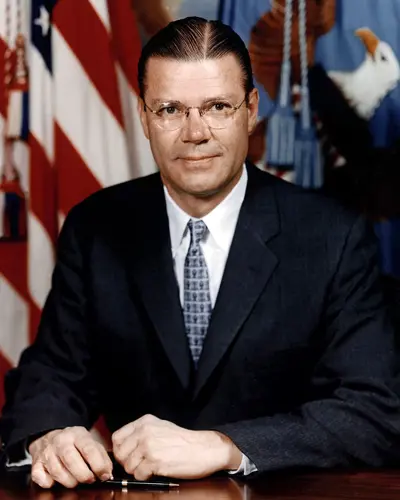
- Born: June 9, 1916
- Died: July 6, 2009
- Nationality: American
- Profession: Public Servant
Robert Strange McNamara was an American business executive and the eighth United States Secretary of Defense, serving from 1961 to 1968 under Presidents John F. Kennedy and Lyndon B. Johnson. He played a major role in escalating the United States' involvement in the Vietnam War. McNamara was responsible for the institution of systems analysis in public policy, which developed into the discipline known today as policy analysis.
