Anthony Zinni Quotes
You can't just answer everything with the application of force. By the time you have to apply force, there's already been a failure, and you're trying to pull your chestnuts out in the worst possible way
Anthony Zinni, Marine Corps General, Commander in Chief, U. S. Forces Central Command, Mid-East Presidential Envoy, Interview, Institute of International Studies, UC Berkeley, March 6, 2001
Sourced by: Eigen's Political and Historical Quotations


For various historical reasons the United States and Iran at that time had no diplomatic relations and there was no easy way for the countries to negotiate their differences. The United States public policy was that Iran would not be allowed to develop a nuclear weapon which was backed up by severe economic sanctions and the threat of military force. Kucinich wanted face to face negotiations and discussions before we resorted to military action.

When there is a serious problem with another country and it appears that military force may have to be used, he and most sophisticated policy makers argue that we should always try diplomacy first. If that does not work, then the military option is still open. If it does work, war or other military action is always available as an option. When politicians do not want to try diplomacy, it is usually that they have an ulterior motive for war and/or military force. Some urge caution with this principle in all cases as sometimes it gives the enemy time to regroup and rearm and he gets stronger by stringing out the negotiations with no intention of a diplomatic solution. In some other cases, as Iran in the second decade of the 21st century when they were suspected of developing a nuclear weapon. The Israeli right wing and some American conservatives wanted no delay in use of military force as that might allow the Iranians to complete an operational message. President Obama and most Americans favored strong economic sanctions with diplomacy first.


The highest court in New York.


In this case, he was referring to the situation with the Barbary Pirates who had an incredible extortion racket going in the Mediterranean. If nations would pay them an annual sum each year, they would not attack and seize merchant ships of that country and sell the ships and goods while holding the sailors for ransom. Jefferson favored and authorized war—a naval attack which for many reasons the European nations had not done (they just paid the tribute). Then a peace treaty was finally signed—the first American Treaty.


Clay in his speech gave credit for the sentiment to Josiah Quincy

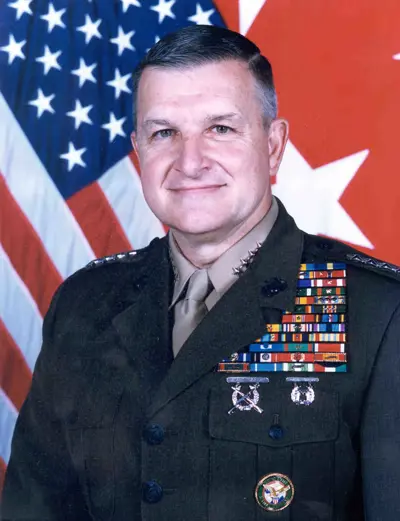
Anthony Charles Zinni is a former United States Marine Corps general and a former Commander in Chief of the United States Central Command (CENTCOM). From 2001 to 2003, he served as a special envoy for the United States to Israel and the Palestinian Authority. From 2017 to 2019, he served as a special envoy to help resolve the Qatar diplomatic crisis.
