William McKinley Quotes
I don't propose to be swept off my feet by the catastrophe.
William McKinley, 1843-1901, 25th President of the United States (Republican, OH), Statement after the explosion of the Battleship Maine when many Americans demanded war.
Sourced by: Eigen's Political and Historical Quotations


He was then a senator. The General would not follow the President’s policy of limiting the Korean war to Korea and publicly advocated and threatened to expand the war to China. See {41470} for President Truman’s policy explanation.


President George W. Bush initiated an invasion of Iraq based on the fact that Iraq was developing nuclear, chemical and biological weapons. After the invasion however, there were none of these weapons found and much evidence that there were not any at that point in time. By the time Congress, the body which is supposed to declare war, found out that the reason for the war was bogus, it was too late. We had already occupied the country and were in the midst of a civil war. The President either acted on bad intelligence or wanted to invade Iraq for other reasons and history may finally tell us which, but Fein sees the problem as too much secrecy in the executive branch.

He had given a speech and then was accused by several representatives He then returned to the podium with this denial. Throughout history many political leaders have started wars to distract the public from the poor economy of other domestic failures. Many others would never do so. All the former, claim that they are the latter.
The reaction of the Kennedy team was very negative to the Russian Proposal with the exception of John McCone who agreed with Kennedy. See {634568}. Neither side had great intercontinental ballistic missile capability at the time, and we had placed a large battery of missiles in Turkey very close to the Russian border. This gave the U. S. a major military advantage. We could deliver many more nuclear warheads to Russia than they could to the United States. The Russians with this proposal hoped to even the capability. The military advisers and the security and State Department advisors all thought that the U. S. should not give up its nuclear superiority. However, we had no international legal basis for denying the Cubans the right to locate any weapons on their soil, so to prevent the Communists from having nuclear missiles in Cuba we would have to use force which could easily escalate into a nuclear war. Kennedy and McCone both thought that since we had intercontinental ballistic missiles in production and coming on line and would not need the Turkey Missiles to strike all over Russia. So giving up our missile advantage for a short time would not expose us to any undue risk. The other advisors worried that the production of the ICBMs could be delayed—weapons systems were (and are) notoriously longer in production than estimated or planned. They also thought that the morale of the military and civilian population would suffer when they learned that we had given away our military advantage. There was a macho element in their thinking in that we would be giving in to intimidation and look like we were afraid to fight. Last, the political advisors thought that the right wing hawks would pillory the administration for its cowardice in allowing itself to be intimidated by the Russians. Their doctrine was that when faced with force, the Communists will always back down. In the final deal we agreed to remove our missiles from Turkey in 6 months and this would be done in complete secrecy and the Russians would keep the deal secret. That way, Kennedy got 6 more months of production which turned out to have been enough. The public would never know till years later and the Conservatives would not be able to publicly castigate Kennedy. Meanwhile, the conservatives would continue to believe that the Russians backed down in the face of force—the naval blockade as this was ‘proved’ their doctrine when the Russians had not backed down at all. The strategy and tactics of the Kennedy administration are still analyzed and argued about today with many Americans just realizing that we did not intimidate the Russians with force or the threat of force to remove their Cuban missiles.


While Abraham Lincoln set the precedent for independent Presidential action in a national political crises without much reliance on Congress, this was where Roosevelt established the precedent of unilateral action in financial crises.

Although Great Britain had abolished slavery, British economic interests during the Civil War suffered because of the Northern blockade of the South. Much political opinion in England was hostile to the blockade policies of the Union. Bright, a great admirer and supporter of the United Sates and the Union cause was concerned that the United States might drift into War with Great Britain. His letter to Senator Sumner was written with the understanding that it would be in shared with President Lincoln, and it was actually read at a cabinet meeting.


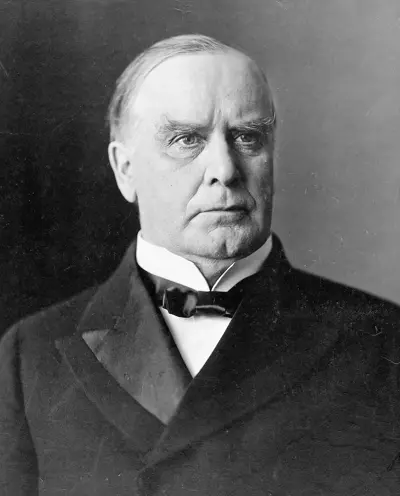
William McKinley was the 25th president of the United States, serving from 1897 until his assassination in 1901. McKinley was president during the Spanish–American War of 1898, raised protective tariffs to boost American industry, and rejected the expansionary monetary policy of free silver, keeping the nation on the gold standard.
