Aníbal Salvador Acevedo Vila Quotes
We should not be forced to give up our children's U.S. citizenship so that we can get a fuller measure of self-government.
Aníbal Salvador Acevedo Vila, Governor of the Commonwealth of Puerto Rico, Statement opposing Puerto Rican Independence, U. S. Senate, Committee on Energy and Natural Resources. Hearings on sovereignty under S. 472, June 23, 1998
Sourced by: Eigen's Political and Historical Quotations


Surprisingly to most people, American Indians born in the United States were not automatically citizens until this law was passed making them so.

Various elements of the 14th amendment were being debated. Language referred to “citizens” but many of the abolitionists and reconstructionists were concerned that the slavery forces in the Southern states would not provide protections to the Negro and the grounds that the were not citizens. As long as the states could define who was and was not a citizen, any of the equal protection clauses of the proposed 14TH Amendment could be evaded. Senator Howard then proposed this language which was accepted and became part of the Amendment. In modern times this particular clause was more relevant to the debate about immigration than to civil rights but originally the clause was included to make sure that Blacks would be citizens.


The 14th Amendment made the Black slaves and their families all citizens as most people know, but it had two other important aspects. It prohibited the individual states from deciding who who was and was not a citizen of the country and the state. In addition, it guaranteed that anyone born in the United States was a citizen regardless of the status of his parents—citizens or not, illegal immigrants or legal.


The requirement for citizenship required the applicant to petition—make a true declaration. The issues of that day that Americans were concerned about were anarchy, polygamy, and loyalty to other nations. A century later, terrorism has taken the place of anarchy as the major concern. Polygamy is no longer an issue, and America allowed citizens to have dual citizenships with many other counties.

This was the first restriction on immigration and citizenship, and was at the time uniquely directed against Chinese.

All foreign immigrants were welcome provided they would “renounce” their allegiance to an foreign ruler or religious leader. The latter was really directed at Roman Catholics. European history had many instances where the Pope and the Vatican plotted with different forces to produce armed rebellion in various states to maintain a Catholic Establishment. England and Ireland were both the subjects of Papal revolutionary initiatives and the Americans were well aware of it. Popes and cardinals had ordered good Catholics to take various political positions including what was treason and sedition. The fear of political control of American Catholics motivated the inclusion of Ecclesiastical renouncement to become a naturalized citizen. Also note that it was the States who controlled citizenship at that time and not the Federal Government.

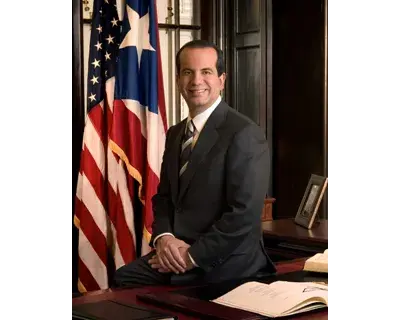
Aníbal Salvador Acevedo Vilá is a Puerto Rican politician and lawyer. He served as Governor of Puerto Rico from 2005 to 2009. He is a Harvard University alumnus (LL.M. 1987) and a graduate of the University of Puerto Rico School of Law, where he obtained his Juris Doctor degree. Acevedo Vilá has held various public service positions in the Puerto Rico government under the Popular Democratic Party, serving as a member of the House of Representatives of Puerto Rico (1993–2001) and as the 17th Resident Commissioner (2001–2005), before he was sworn in as Governor on 2 January 2005. Acevedo Vilá was also a member of the National Governors Association, the Southern Governors' Association and the Democratic Governors Association, and a collaborator of President Barack Obama's presidential campaign. Also he is currently an adjunct professor of the University of Puerto Rico School of Law. In 2019 he announced he would run for Resident Commissioner of Puerto Rico in the 2020 elections by the Popular Democratic Party.
