Woodrow Wilson Quotes
We shall not, I believe, be obliged to alter our policy of watchful waiting.
Wilson, Woodrow. "First Annual Message to Congress." 2 Dec. 1913. The Public Papers of Woodrow Wilson, edited by Ray Stannard Baker and William E. Dodd, vol. 3, Harper & Brothers, 1927, p. 38.


Shortly thereafter the United States joined the allies and the First World War.


This quotation illustrates White’s extreme naivety about Stalinist Russia. At the time the Soviet Union had been backing communist insurgencies blatantly in China, Greece, and Korea for example. Most historians agree that White passed classified information to the Russians. He was accused of being a Communist, but there was never any evidence of that. Some people believe that he was a spy for the Russians and committed espionage, but others disagree observing that White was very much his own man and felt that much information that was classified never should have been. White substituted his own judgment, it is believed, about what could be given to the Russians. He was an admirer of what Russian socialism had accomplished economically, educationally and medically since the 1917 revolution deposing the Czar. Russia had been a valuable military ally, which had taken the brunt of both military and civilian casualties in WWII. White’s economics were certainly not Marxist but very much Keynesian. He was subpoenaed by the House Un-American Activities Committee where he was accused of being a Communist which he denied (see {634907}). He died of a heart attack 3 days later.


By the standards of the rest of the world the North Korean policies and actions were at the time irrational and inconsistent and explained in a manner which defied any norms that any other nation’s leaders could understand and explain.


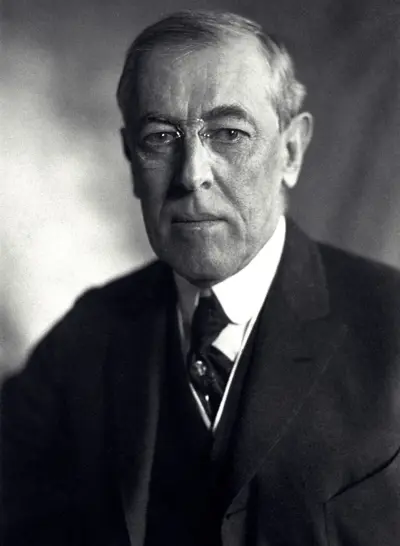
Thomas Woodrow Wilson was an American politician and academic who served as the 28th president of the United States from 1913 to 1921. A member of the Democratic Party, Wilson served as the president of Princeton University and as the 34th governor of New Jersey before winning the 1912 presidential election. As President, Wilson led the United States into World War I in 1917. He was the leading architect of the League of Nations, and his progressive stance on foreign policy came to be known as Wilsonianism. Scholars have generally ranked Wilson in the upper tier of U.S presidents, although he has been criticized for supporting racial segregation and white supremacy.
