James Buchanan Quotes
To avoid entangling alliances has been a maxim of our policy ever since the days of Washington, and its wisdom no one will attempt to dispute.
Buchanan, James. "Inaugural Address." 4 Mar. 1857. A Compilation of the Messages and Papers of the Presidents, 1789-1897, edited by James D. Richardson, vol. 5, Government Printing Office, 1897, p. 436.

Shortly thereafter the United States joined the allies and the First World War.


The “entangling alliances” phrase was first used by Thomas Jefferson in his First Inaugural Address. He had been Secretary of State in George Washington’s cabinet. The phrase is often misattributed to Washington. The sentiment was definitely his also however.

Inscribed in the John Adams Building of the Library of Congress. On this subject Jefferson was in agreement with George Washington {37176} and his political opponent, John Adams {592705}.


Senator Burton was using this quotation to support the Republican isolation policy that they were advocating at the time. This quotation has been cited by almost every American politician advocating isolationism. Generally it was the Republican party that has been the isolationist advocates in America. However, after the Second World War that began to change, and in the beginning of the 21st century, the George W. Bush Administration, without any declaration of war by Congress, attacked and invaded two different countries starting the Iraq and the Afghanistan Wars. Meanwhile, the Democrats, who had been advocating American activism in foreign affairs also flip flopped and opposed foreign military intervention as Democratic President Obama withdrew American troops from the two Bush wars. The Afghanistan War was the longest war in American history.


This is one of the favorite quotations of American isolationists. Try as he and others did, they found the principle easier to utter than implement. Jefferson, having diplomatic experience in Europe knew far more than most Americans about foreign affairs, and he used this knowledge well on many occasions in playing off the French, Spanish and English against each other regarding their interests in America. By purchasing the Louisiana Territory from Napoleon, he not only greatly increased the size of the nation but all but eliminated Spanish aspirations in North America. At the same time the money he gave Napoleon increased the French threat to England, Spain and other European countries. So Jefferson and America was in European “broils” as the advantage and necessity outweighed the general principle and dislike for those machinations.


She was explaining the general American’s hostility toward diplomacy.

The Spanish had been beaten and bloodied by England, but no one else until Napoleon would come along later. So it was easy for Spain to bully and dominate the non-English countries.


See {640831} for more on this subject.

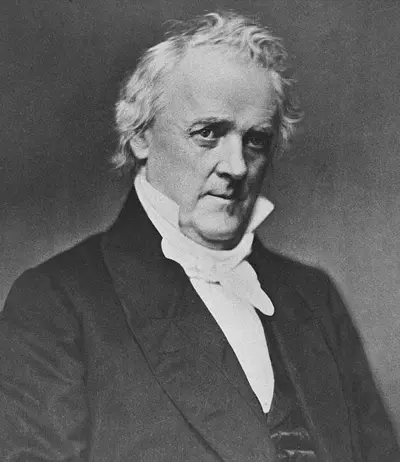
James Buchanan, Jr. was the 15th President of the United States (1857–61), serving immediately prior to the American Civil War. He represented Pennsylvania in the United States House of Representatives and later the Senate, then served as Minister to Russia under President Andrew Jackson. He was named Secretary of State under President James K. Polk, and as of 2016[update] is the last former Secretary of State to serve as President of the United States. After Buchanan turned down an offer to sit on the Supreme Court, President Franklin Pierce appointed him Ambassador to the United Kingdom, in which capacity he helped draft the Ostend Manifesto.; James McGill Buchanan, Jr. was an American economist known for his work on public choice theory (included in his most famous work The Calculus of Consent), for which he received the Nobel Memorial Prize in 1986. Buchanan's work initiated research on how politicians' and bureaucrats' self-interest, utility maximization and other non-wealth maximizing considerations affect their decision making. He was a member of the Board of Advisors of The Independent Institute, a member (and for a time the President) of the Mont Pelerin Society, a Distinguished Senior Fellow of the Cato Institute, and professor at George Mason University.
