James K. Polk Quotes
No person can be more deeply sensible than myself of the danger of entangling alliances with any foreign nation. That we should avoid such alliances has become a maxim of our policy consecrated by the most venerated names which adorn our history and sanctioned by the unanimous voice of the American people.
Polk, James K. "Speech on the Mission to Panama." Register of Debates in Congress, vol. 2, part 2, Gales and Seaton, 1826, p. 2490.


Inscribed in the John Adams Building of the Library of Congress. On this subject Jefferson was in agreement with George Washington {37176} and his political opponent, John Adams {592705}.

Shortly thereafter the United States joined the allies and the First World War.


The American sense of exceptionalism of the democratic republic we created and the almost messianic duty to extend freedom and democracy throughout the world is actually relatively new in American history. For most American existence, the sense of the desirability of spreading the American freedom was held from the very beginning, but it was very much inhibited by American isolationist tendencies and entanglements on other nation’s affairs.


Adams was in agreement with his former chief George Washington {37176} as well as with many of his political foes.


The “entangling alliances” phrase was first used by Thomas Jefferson in his First Inaugural Address. He had been Secretary of State in George Washington’s cabinet. The phrase is often misattributed to Washington. The sentiment was definitely his also however.

This is one of the favorite quotations of American isolationists. Try as he and others did, they found the principle easier to utter than implement. Jefferson, having diplomatic experience in Europe knew far more than most Americans about foreign affairs, and he used this knowledge well on many occasions in playing off the French, Spanish and English against each other regarding their interests in America. By purchasing the Louisiana Territory from Napoleon, he not only greatly increased the size of the nation but all but eliminated Spanish aspirations in North America. At the same time the money he gave Napoleon increased the French threat to England, Spain and other European countries. So Jefferson and America was in European “broils” as the advantage and necessity outweighed the general principle and dislike for those machinations.
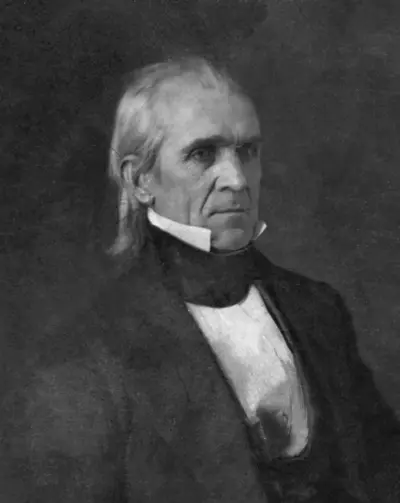
James Knox Polk was the 11th president of the United States, serving from 1845 to 1849. He previously was Speaker of the House of Representatives (1835–1839) and Governor of Tennessee (1839–1841). A protégé of Andrew Jackson, he was a member of the Democratic Party and an advocate of Jacksonian democracy. Polk is chiefly known for extending the territory of the United States through the Mexican–American War; during his presidency, the United States expanded significantly with the annexation of the Republic of Texas, the Oregon Territory, and the Mexican Cession following the American victory in the Mexican–American War.
