Jimmy Carter Quotes
Every time something has gone wrong with foreign policy, it’s been because the American people have not been involved in the process.
Jimmy Carter, 39th President of the United States (Democrat, GA), Presidential Campaign Debate with Jerry Ford, October 6, 1976
Sourced by: Eigen's Political and Historical Quotations


The public desire to know about and influence the details about diplomatic affairs is not just a problem of the 21st century. Here the Secretary of State describes it in 1922.


This quotation not only illustrates the discomfort of the atomic scientists who developed the atomic bomb regarding the ethics and decision making regarding use, but also how complex a man Teller himself was. Here he sounds like a left-leaning centrist. A little later he would side with the hawks in the military and the political world and slander his colleague Oppenheimer publicly advocating an arms race and the development of the hydrogen bomb when the existing technology of the atom bomb could wipe out Russia or any other nation. His new allies however kept everything about nuclear weapons a secret and thus the public could never weigh in and influence any nuclear decision making. This state existed until President Eisenhower declassified much of the nuclear weapons information as part of his Atoms for Peace program.


It was only since Theodore Roosevelt’s presidency that the public received very much information about what the nation’s foreign policy was or was even desired except in time of war.


The railroads were nationalized for WWI and he ran them all as a government official

Senator Dianne Feinstein, Chairman of the Senate Intelligence Committee, had released an unclassified Summary of the Committee Report on the CIA using torture and perverse treatment of suspect terrorists in the aftermath of the 9-11 attack on New York. Most Republicans argued vehemently that the Report should be classified and kept secret as the CIA behavior was so egregious, unpalatable, and morally reprehensible that there would be negative consequences including perhaps demonstrations and attacks against Americans in foreign countries. Moreover, Terrorist organizations would use the heinous CIA behavior as a recruiting tool for anti-American terrorists. McCain, who had himself been the victim of North Vietnamese torture cited the moral and ethical reasons to prohibit torture but also explained what has been proven over and over again that torture victims will tell the torturer any nonsense that they think the torturer might believe just to get obtain relief from the agony of the torture.
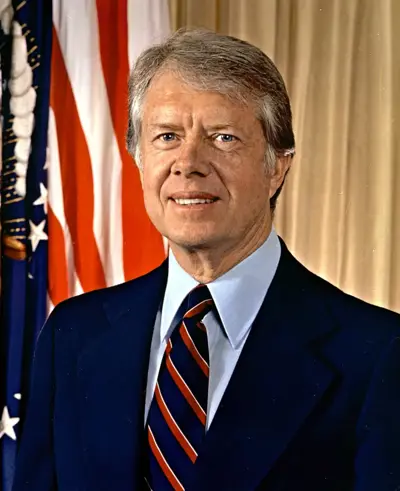
James Earl Carter Jr. is an American politician, businessman, and philanthropist who served as the 39th president of the United States from 1977 to 1981. A member of the Democratic Party, he previously served as a Georgia State Senator from 1963 to 1967 and as the 76th governor of Georgia from 1971 to 1975. Since leaving the presidency, Carter has remained engaged in political and social projects as a private citizen. In 2002, he was awarded the Nobel Peace Prize for his work in co-founding the Carter Center.
