Chester W. Nimitz Quotes
We shall never forget that it was our submarines that held the lines against the enemy while our fleets replaced losses and repaired wounds.
Nimitz, Chester W. Navy Day Message to the Submarine Force. 27 Oct. 1945.


He didn’t succeed until Mahan wrote his marvelous treatise.


The Persians arrived at an abandoned city and burned some of the major buildings. All the Athenian men went to the island of Salamis where he gathered Greeks from the other city states. They boarded ships and tricked the march larger Persian fleet into coming into the narrow part of the straits where it could not maneuver. The Greeks destroyed the Persian fleet with relatively few losses and with it went Xerxes dreams of conquest of the Greeks. The Persian navy could not feed their army and the Persians, the greatest empire of the day, retuned to Persia in defeat.

In 1930, Japan, Britain, and the United States had signed an agreement that submarines would not sink merchant vessels without having first placed passengers and crew in a place of safety. However, when Japan attacked Pearl Harbor and bombed civilians as well as military and had a pattern of bombing and shelling civilians in China, the U. S. took the position that Japan had abrogated all treaties and therefore abrogated the 1930 treaty. It was more of a symbolic gesture as at the time the American forces were in no shape to attack Japanese merchant shipping though later in the war, it became material. By that time, the Japanese had murdered American prisoners of war on the Bataan Death March and elsewhere and had slaughtered civilians in the Philippines and all the other territories that they invaded. The niceties of the 1930 treaty was one of the first casualties of Japanese aggression.

The German naval command—without the permission of the Kaiser—at the eve of a losing war decided that the entire German navy would make a grand attack against the far superior English fleet. It was to be a virtual suicide attack on a grand scale. However, most German sailors heard about the plan and refused orders to attack in what was the largest mutiny in history. The German naval leaders then took the fleet out to sea and scuttled all the ships so that the English would not capture them. The result was the same but tens of thousands of lives were saved; many German officers felt that German naval honor had been lost.


Military men tend to rely so much on military history that they are almost always fighting the last war. Soon air power would supplant sea power as the critical factor. Then nuclear power, and then nuclear weapons became too severe for actual use and yet wars still continued with no consensus as to that will be in the future.

He was referring to attacking the Barbary States. The Barbary Pirates had an incredible extortion racket going in the Mediterranean. If nations would pay them an annual sum each year, they would not attack and seize merchant ships of that country and sell the ships and goods while holding the sailors for ransom. See {640846}.


The Germans did not believe the British would send land troops. See {642105}.
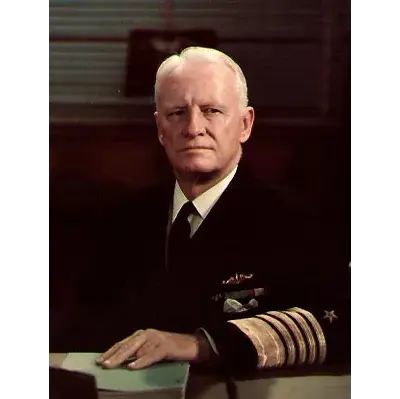
Chester William Nimitz was a fleet admiral of the United States Navy. He played a major role in the naval history of World War II as Commander in Chief, U.S. Pacific Fleet and Commander in Chief, Pacific Ocean Areas, commanding Allied air, land, and sea forces during World War II.
