Tacitus Quotes
We must endure the luxury and avarice of sovereigns, as we endure the barrenness of a soil, storms, and other inconveniences of nature. There will be vices as long as there are men; but these are not continual, and are recompensed by the intermixture of better qualities
Cornelius Tacitus, c. 55-c. 117, Roman Historian, History
Sourced by: Eigen's Political and Historical Quotations

See {620510} for a much older expression of this idea.

His army had been so successful that many of his men had all the riches they ever dreamed of and great glory as well. Some just wanted to slow down and enjoy the conquered lands where they had been received very cordially as Alexander’s “occupation” was much more benign than the Asian rulers had been. So some of Alexander’s men were critical of Alexander and in effect, Alexander said that the complaints are what a successful king should expect after so much success and popularity. This quotation was inscribed in Latin on the town-hall of Zittau, in Saxony during the reign of Frederick The Great. Politicians have been comforted by Alexander’s quotation even to modern times. Also, see {632232} for Voltaire’s version of Alexander’s statement.


Although he was the first Western philosopher to emerge from the dark ages, he was one of the great advocates for freedom of speech and freedom of thought. He not only was publicly critical of many authority figures of the day, but he refused Pope Nicholas I’s orders to submit his work to Church censorship. He was supported by King Charles nonetheless, but various church councils condemned many of his writings. Ironically, one of his works that caused so much criticism was a defense of one of the views of Hincmar, the cleric who he attacked in the quotation. The radical notion was that the destiny of an individual is not totally dependent upon God, but that man has been given free will and that has some part in determining salvation.


Ireton was one of the leaders of the Parliament faction in the English Civil War. He was such an important figure that when King Charles II regained power after Ireton’s death, Charles II was so rabid that he had Ireton’s body dug up, along with that of Cromwell and John Bradshaw, and mutilated as the would have been had they been executed.
Husayn Ali Nuri. This was a series of letters which he wrote to Napoleon, the Sultan and the other rulers of the day. At the time he was exiled to Edirne by Ottoman Sultan Abdulaziz.


She was at the time the European Commissioner for Competition


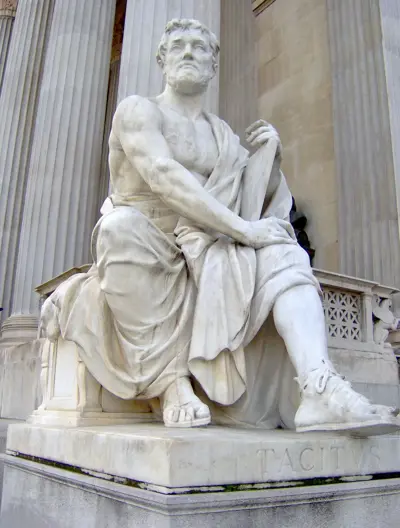
Publius (or Gaius) Cornelius Tacitus (AD 56 – c. 120) was a Roman historian and politician. Tacitus is widely regarded as one of the greatest Roman historians by modern scholars. He lived in what has been called the Silver Age of Latin literature, and has a reputation for the brevity and compactness of his Latin prose, as well as for his penetrating insights into the psychology of power politics.
