Calvin Coolidge Quotes
We desire to see France paid and Germany revived, and as the creditor of Europe we would not wish to assume the role of an oppressive creditor, but would maintain the principle that financial obligations between nations are likewise moral obligations, which international faith and honor require should be discharged.
France had lost almost all their wealth during WWI. Under the Peace Treaty of Versailles, Germany was supposed to pay France (and others) for the damage and destruction they had wrought. If Germany did not pay the reparations, France could not rebuild. And if Germany did pay the reparations, Germany could not rebuild. The United States at that time was not rich enough to help Europe rebuild.
Calvin Coolidge, 1872-1933, 30th President of the United States (Republican, MA), Statement on the repayment of American WWI loans by our Allies, Quoted in George Percival Auld, “The Reparation Problem Today”, Foreign Affairs, March 1924
Sourced by: Eigen's Political and Historical Quotations


Saint-Just himself was executed at the age of 27 by the mechanism he had created.


Debts accumulated by the allies in World War I was still outstanding a decade later. When it was proposed that the United States help reduce this debt, President Coolidge remarked:

The Germans wanted to make a deal with Britain to remain neutral while Germany attacked and conquered France’s colonies. In their view England and Germany would share the dominance of the world. The British would not sell out the French with whom they had a treaty, and WWI began.


There were critics of the Treaty of Versailles in Britain as well as the United States.

When it came to war and national honor, TR was a super hawk. His usual subtlety of analysis became gross and binary when war was considered. Opposition was greed and cowardice and never considered policy options.

After WWI, the Germans were reluctant to make the reparation payments that they had agreed to in the WWI peace treaty. The French, to “motivate” the Germans, occupied the German Ruhr Valley—an area that contained very important German heavy industry and coal mines that could not function under the occupation. See {640090}.

He was arguing that even if torture might provide useful intelligence not otherwise obtainable, it is not necessary in order for us to succeed in our objectives. Ironically, the military interrogation rules prohibited torture in conformity with US law and treaties but the CIA ignored those restrictions and secretly tortured a number of victims in the War on Terror until their actions became public and they too were required, by executive order to follow the military interrogation guidelines.


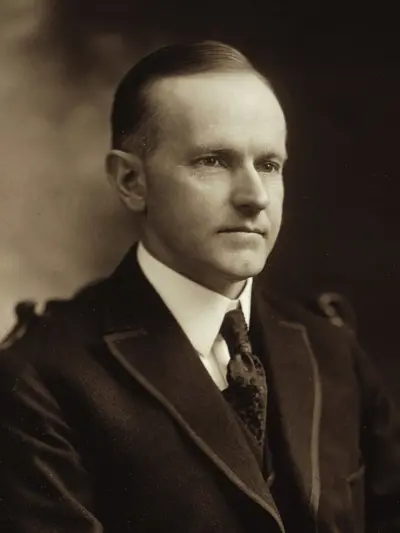
Calvin Coolidge was an American lawyer and politician who served as the 30th president of the United States from 1923 to 1929. A Republican lawyer from New England, born in Vermont, Coolidge worked his way up the ladder of Massachusetts state politics, eventually becoming governor of Massachusetts. His response to the Boston Police Strike of 1919 thrust him into the national spotlight and gave him a reputation as a man of decisive action. The next year, he was elected the 29th vice president of the United States, and he succeeded to the presidency upon the sudden death of Warren G. Harding in 1923. Elected in his own right in 1924, he gained a reputation as a small-government conservative and also as a man who said very little and had a rather dry sense of humor.
