Ulysses S. Grant Quotes
To protect the national honor, every dollar of Government indebtedness should be paid in gold, unless otherwise expressly stipulated in the contract. Let it be understood that no repudiator of one farthing of our public debt will be trusted in public place, and it will go far toward strengthening a credit which ought to be the best in the world.
Ulysses S. Grant, 1822-1885, 18th President of the United States (Republican, OH), First Inaugural Address, March 4, 1873
Sourced by: Eigen's Political and Historical Quotations

A minority group of very conservative members of the House of Representatives had decided to hold America’s full faith and credit and the economy hostage to implementing their minority proposal to reduce government spending more than the majority wanted shortly after the 2012 election where the voters had rejected the conservative position. None the less, they were threatening to force the government to default and not pay for the items that the Congress had previously already approved by not approving a debt ceiling increase. The President was determined not to negotiate with “hostage takers” and making sure that America paid its bills for the money spent as authorized by Congress.


The Republicans who had control of the House of Representatives were reaching the end of the fiscal year and had not yet passed a budget nor expanded the debt ceiling so the government would have to shut down in a few days and a little later America could not pay any of its bills. They had a very strong position if they willing to blackmail the Democratically controlled Senate and the Democratic President. But the last time the Republicans had ever tried this before was the Republican House when Gingrich was speaker and they shut down the government for almost 3 weeks. It cost the Republicans the next election’s majority in the House. President Obama decided that he would not set a precedent of negotiating with a house of Congress that was threatening to shut down the government or threatening not to pay the nation’s bills which Congress had already authorized the purchase of.


Debts accumulated by the allies in World War I was still outstanding a decade later. When it was proposed that the United States help reduce this debt, President Coolidge remarked:


See {604501} for another of his statements. It was Alexander Hamilton who called the national debt a national blessing. See {207891}. Jackson was convinced that a moneyed class who held the national debt could dictate to any administration by threatening to not renew their bonds. The same concern was expressed at the beginning of the 21st century regarding the Chinese and the Middle Eastern countries which held do many of our bonds.
Historically, this is the occasion where the war debt from the Revolution and the War of 1812 was paid off. It was one of the few times that the nation was debt free.


At the time, many conservatives were threatening not to increase the debt ceiling unless they could get their way on the budget negotiations which would come up later. The Congress had earlier actually committed to spend the amounts when they voted the appropriations that enabled the spending and increasing the debt. Most countries do not have this second stage in that there is nothing the Congress can possibly do to change get back the money that they already voted to be spent, and the process of raising the debt ceiling must be done else the “full faith and credit” of the United States.


France had lost almost all their wealth during WWI. Under the Peace Treaty of Versailles, Germany was supposed to pay France (and others) for the damage and destruction they had wrought. If Germany did not pay the reparations, France could not rebuild. And if Germany did pay the reparations, Germany could not rebuild. The United States at that time was not rich enough to help Europe rebuild.
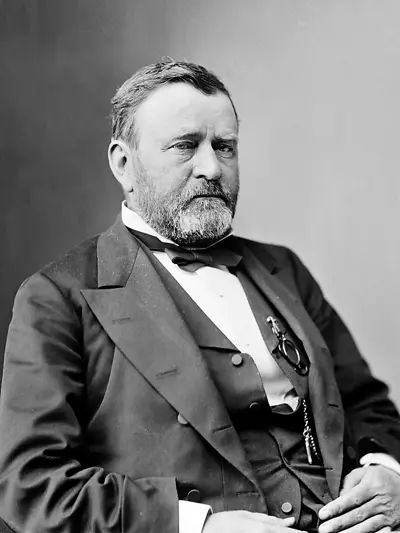
Ulysses S. Grant was an American military leader who served as the 18th president of the United States from 1869 to 1877. As president, Grant was an effective civil rights executive who created the Justice Department and worked with the Radical Republicans during Reconstruction to protect African Americans. As Commanding General, he led the Union Army to victory in the American Civil War in 1865 and thereafter briefly served as Secretary of War.
