Sergei Lavrov Quotes
We can say that Japan is the only country that calls into question the outcome of the Second World War; no one else does.
Lavrov, Sergey. Press Conference following talks with Japanese Foreign Minister Taro Kono. The Ministry of Foreign Affairs of the Russian Federation, 14 Jan. 2019.


This quotation is important because the American public and their leaders saw only one course of action—invasion of the Japanese Mainland. The debate was whether to attempt the invasion right away or bomb and blockade Japan into destruction and starvation weakening the population so their resistance would not produce the kind of casualties that we had experienced with the Invasion of Okinawa. The bombing and blockade strategy was selected and 80 percent of Tokyo was obliterated. Yet the Japanese refused to surrender even after all its manufacturing capability was destroyed and the agriculture was beginning to be destroyed. Most Americans did not realize it but the atomic bomb was being made ready for use. After the test bomb in New Mexico, we had enough fissionable material for 2 bombs and it would take several months for each additional bomb. The use of the atomic bomb at the time seemed not much different from the massive bombing that had already taken place. More Japanese were killed in some of these conventional bombings than with the Atomic Bomb. The key believe was that the Japanese would not give up. After the first A bomb, they still would not surrender, and when the Emperor decided on surrender after the 2nd bomb, there was a military insurrection in the palace to stop the Emperor’s surrender message to the people from being broadcast. It was just minutes too late, and the Emperor had to be obeyed. Invasion, with its terrible casualties—many more than the atomic bombs—was unnecessary.


This quotation has been used by many criticizing the policy of massive bombing of Japanese Cities towards the end of the war. At first it appears that there was a racist disregard for Japanese Civilian lives. However there was legal logic. The Japanese had already bombed cities throughout Asia and did not adhere to the rules of war. The Japanese government “invited” all Japanese to join the military to defend the homeland to the death in the coming invasion. All adult civilians were mobilized. There were no adult civilians left in Japan. Perhaps more important was the industrial organization of Japan which exists in large part to this day. There were tens of thousands of small & tiny factories distributed throughout all the Japanese cities. These were distributed in civilian areas & in many cases were actually in homes to take advantage of available labor and not have to transport people. There was no way to bomb the munitions factories without bombing civilian neighborhoods.


Leval was an appeaser and a collaborator with the Nazi’s. He led the government in name but the Germans really controlled the country. His actions killed tens of thousands of French men and women by turning them over to the Germans. After the Germans were defeated in WWII, Leval was shot as a traitor by the Free French forces.
Although Emperor Hirohito had the status of a God, and his Prime Minister and Chief of the Military testified that they had never disobeyed the Emperor {587278}, there was a thorough attempt to whitewash the Emperor’s role—{587279}. Few Japanese, even years later would suggest that Hirohito might bear some personal responsibility. The Mayor was one of the few who made the statement of the obvious. He received 181 death threats and he was shot shortly thereafter by a right wing supporter of the Emperor’s.
Some say that President Roosevelt had instructed the war department to issue warnings to the military forces in the Philippines and the Pacific. Military intelligence argued against the Japanese attack on the Philippines—and did not think any attack anywhere very likely. When the president insisted, warnings went out and this is what was sent to General Short. The warning was ambiguous and Short did very little and was caught unprepared shortly thereafter. How much reliance should be placed on intelligence estimates has been a question that has been argued before World War II and after.

He was describing a meeting that he and General Marshall had conducted with FDR, Secretary of State Cordell Hull and others. In less than two weeks, the Japanese would attack Pearl Harbor without any declaration of war, as Marshall had predicted.

Truman had been briefed on the number of Japanese who committed suicide rather than surrender—including civilians—in Saipan, Okinawa, Iwo Jima, and other locations where United States troops had invaded. He and his experts agreed that the Japanese would not surrender unless there was a new dramatic factor that was outside the usual thinking—the atomic bomb. He was proved right about the warning. Not only did the Japanese ignore it, but they did not even surrender after the nuclear devastation at Hiroshima. It took a second bomb dropped on Nagasaki to motivate the surrender. So even a demonstration with all those Japanese casualties did not cause the surrender until it was repeated.

America, England, Germany and France Many Japanese leaders predicted war between the Great Powers while America and its European Allies did not see the danger as clearly. Shortly after 1936, Hitler began the Second World War. Japan was indeed prepared. Hiranuma became one of the Japanese extremists and after WWII was convicted of war crimes and given a life sentence.


In the earliest prediction of the World War II conflict between America and Japan:
It was never submitted as evidence in any proceeding or made a part of the U. S. investigatory record of war crimes of World War II. Nor was it ever found in Japan in the official records. The only copy was found in 2003 at the home of Bonner F. Fellers one of MacArthur’s top aids in the Japanese Occupation. Fellers and McArthur advocated not further investigating or trying the Japanese Emperor either because they, believed he was not guilty or because they thought his trial would be too disruptive to the occupation. The authenticity of this monologue has not been verified. Apologists for the Emperor argue that it shows that he was a virtual prisoner of the militarists and unable to stop the war or any of the war crimes; others argue that the Japanese military would never have gone against the will of the Emperor and that this document was probably prepared with the coaching of General Fellers as ex post facto “evidence” of the Emperor’s innocence. See {643148} and {601309} for examples of Fellers manipulating the “evidence.”
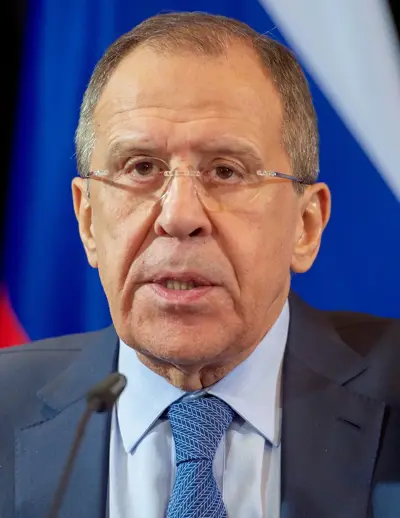
Sergey Viktorovich Lavrov is a Russian diplomat and politician who served as the Foreign Minister of Russia since 2004. As a member of the United Russia party, he was previously the Permanent Representative of Russia to the United Nations, serving in the role from 1994 to 2004.
