Leo XIII Quotes
We are not able to give approval to those views which, in their collective sense, are called by some "Americanism." But if by this name are to be understood certain endowments of mind which belong to the American people, just as other characteristics belong to various other nations, and if, moreover, by it is designated your political condition and the laws and customs by which you are governed, there is no reason to take exception to the name. But if this is to be so understood that the doctrines which have been adverted to above are not only indicated, but exalted, there can be no manner of doubt that our venerable brethren, the bishops of America, would be the first to repudiate and condemn it as being most injurious to themselves and to their country. For it would give rise to the suspicion that there are among you some who conceive and would have the Church in America to be different from what it is in the rest of the world.
Papal letter to Cardinal James Gibbons. For an example of Gibbon’s strong loyalty to America, see {611353}.
Leo XIII, 1810-1903, Roman Catholic Pope, Testem Benevolentiae Nostrae, January 22, 1899
Sourced by: Eigen's Political and Historical Quotations


The hypocricy of this slogan is almost incredible. Most of the actions of the KKK over the years have violated the spirit and the laws of America. They are opposed to many of the Bill of Rights. There was a time, before the 1970s, where members literally got away with murder in the South. When Americas laws were enforced and KKK members who broke the law were jailed and sued for monetary damages, the Klan has a very tiny membership and is constantly under survelience.

At the time there was no pope. Before an election for one was held, all the electors made the collective oath and promise to maintain the idea of a council of clerics if he were elected Pope. After the Pope was elected, the bishops solidified their power even claiming ascendancy and authority, when assembled, over the Pope. See the Council of Constance {610980} 6 years later.

First Irish Bishop in the United States. American Catholic bishops were divided during the Civil War over the slavery question. For a bishop’s view opposing slavery, see Purcell {612351}.

In addition to being a Roman Catholic priest, Father Coughlin was an outspoken radio commentator who was well known for his controversial political opinions, see {598783}, {598784}.


See {617354} for what stimulated the issue.


Carroll was writing to Troy during the time of the question of Catholic emancipation in England. Here he is clearly alluding to the British form of government. Carroll never missed the opportunity to champion religious freedom as manifested in the U.S. Constitution. For an earlier example of his praise for religious freedom, see {596933}.

The struggle in the Catholic Church reached an amazing state. Just after a new pope, Martin V, had been elected the Council of Bishops at Constance came up with this notion which placed their views above those of the Pope under the theory that this particular council derived its power and authority directly from Christ while the pope was only God’s “vicar on earth.” The struggle was somewhat akin to the inevitable struggle for power between an executive branch and a legislative branch. The Council’s ascendancy didn’t last very long and was repudiated by successive popes.

The Mystery was for many years the only Black Newspaper in America.


Although a member of the Prime Minister’s party and Cabinet, Cooper was so outraged that he called for Chamberlain’s resignation leading to Winston Churchill becoming Prime Minister.

See {613385} ,{588836}, {613384}, {613381}.

when the encyclical Casti Connubii was promulgated This was written before he was elected Pope. At the time there was some movement within the Catholic Church towards the possible liberalization of the traditional prohibition against birth control of any kind. At the time Montini was in the minority on the Commission, and after he assumed the Papacy, he became a majority of one.


He was an American resident at the time he gave this speech.


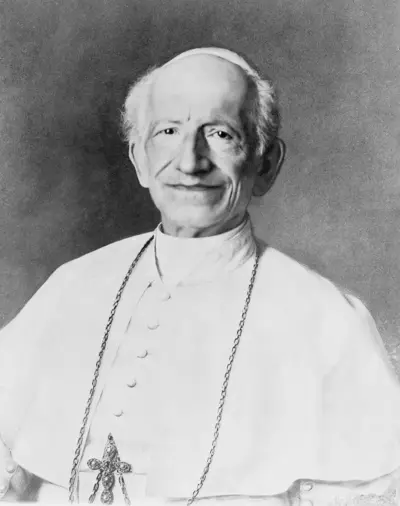
- Born: March 2, 1810
- Died: July 20, 1903
- Nationality:
- Profession:
Pope Leo XIII was the head of the Catholic Church from 20 February 1878 to his death in 1903. He was the oldest pope (reigning until the age of 93), with the exception of Pope Benedict XVI as emeritus pope, and had the third-longest confirmed pontificate, behind those of Pius IX (his immediate predecessor) and John Paul II.
