John C. Calhoun Quotes
We are not a nation, but a union, a confederacy of equal and sovereign states.
Dyer, Oliver. Great Senators of the United States Forty Years Ago (1848 and 1849). Robert Bonner's Sons, 1889, p. 180.


Maryland had not yet ratified, and was not to do so until March 1, 1781, yet Jay operationalized the new nation with this letter.


The words are those of President Andrew Jackson. See {604550}. After occupying New Orleans, General Butler infuriated the Confederate Sympathizers with this act. Jackson was the hero of the Battle of New Orleans and an unapologetic slave owner. The Southerners had erected a magnificent statue of their hero Jackson on horseback in a major section of the city. Butler, then ordered that the Jackson quotation be chiseled in the stone base. The townspeople were furious that this Union General would make up words and attribute them to Jackson; however, when they finally realized that Jackson had actually said those words they felt even more humiliated. There are still a few Southernors who consider this terrible insult to the Confederacy, and of course that is just what Butler intended.

When the 13 states were united only by the loose bonds of the Confederation, Jefferson wrote:


The First and Official Use of the Name

While not generally known, the Articles of Confederation contemplated the strong possibility that Canada would become part of the United States. However, there was too strong a Tory element in Canada and it did not happen. The Constitution was not drafted until 1787 and was ratified later. In the interim the young United States functioned under the Articles of Confederation, in a sense, our first Constitution.


Abraham Lincoln’s major political opponent in Illinois agreed with Lincoln on the criticality of preserving the Union from a split off of the Southern States. He tended to be more willing to pander to the South than Lincoln, however they were strong allies on the fundamental issue. However, what the slavery forces in the south wanted and needed to forever protect slavery was not in the power of any President to do, short of ending the democracy. Slavery was doomed in the long run if there was no way to enforce the Supreme Court’s Dredd Scott decision upon (Northern) states whose constitutions and laws made any slave who entered the state free and whose people would not use its police and legal powers to return runaway slaves. It was the abolitionists who won the majority in the battle of public opinion on slavery. It was only a matter of time when slavery would become untenable in the South. Lincoln was unwilling to force the Northern states to return fugitive slaves against the constitution, laws and will of the people of those states as Buchanan said he was (but had a hard time doing). Also Lincoln was unwilling to allow new territories to enter the union if they allowed slavery.

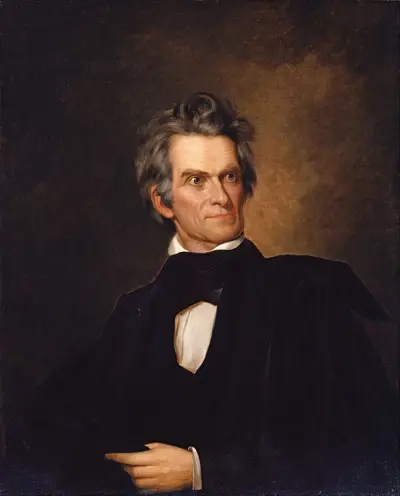
John Caldwell Calhoun was an American politician and political theorist from South Carolina who held many important positions including being the seventh vice president of the United States from 1825 to 1832, while adamantly defending slavery and protecting the interests of the white South when its residents were outnumbered by Northerners. He began his political career as a nationalist, modernizer, and proponent of a strong national government and protective tariffs. In the late 1820s, his views changed radically, and he became a leading proponent of states' rights, limited government, nullification, and opposition to high tariffs. He saw Northern acceptance of those policies as a condition of the South remaining in the Union. His beliefs and warnings heavily influenced the South's secession from the Union in 1860–1861.
