Rached Ghannouchi Quotes
We are Muslim democrats, not Islamists
The "we" referred to the Tunisian Ennahda Party of which he was the founder.
Quoted in Middle Ease Eye September 14, 1916 http://www.middleeasteye.net/news/ennahda-leader-gannouchi-we-are-muslim-democrats-not-islamists-1710821541
Sourced by: Eigen's Political and Historical Quotations

The party to which he was referring was the Ennahda Party of which he was a founder. Note that party's acknowledgement that Islamic extremists had hijacked the terms "Islamic" and "Islamism", thus requiring them to change vocabulary to distinguish themselves and their more democratic values.


Turkey had become a modern, secular nation under the leadership of Ataturk. At the time of this interview, a religious party had won a plurality of seats in the Parliament and while not rolling back the secular nature of the Turkish state which is enshrined in the Turkish Constitution, has tried to stem the tide of secularism.

Ironically, without the word “wicked” most people would regard the first sentence as a good description of elements of a modern democracy. It illustrates that for the Islamic fundamentalist democracy substitutes the rule of man for the rule of God, freedom of speech allows heresy and blasphemy to to uttered and communicated, and religion which is supposed to inform and direct politics. So what is good for the lover of democracy is the very thing that is bad for Islam. This is not a uniquely Islamic viewpoint. It has been and is held by fundamentalist Christians and Jews as well who would return to Biblical law punishing blasphemy and heresy with death and have religion drive all politics.


This is a very Jeffersonian type statement.


Journalists and writers are among the most persecuted people in Islamic nations and even writers in non-Muslim nations have been murdered and intimidated for writing material that fundamentalist Muslims thought was heresy.


In 2005 Rose published a number of cartoons some of which depicted the Muslim Prophet, Muhammad which offended many fundamentalist Muslims who had a tradition who had a tradition of never depicting the visage of the Prophet. A delegation of clerics demanded an apology from Rose and the country of Denmark, claiming that they and Islam, like other religions, were entitled to respect.


The notion that Islam would be practiced by individuals was in the Ayatollah’s view insufficient. Islam must also control the government—the head.

On the surface, this reform seems to contradict Sharia – Islamic religious law -- where religion permeates all of politics.

This statement was made 20 years before the Arab Spring of 2011.

Abdul Rahman, Afghan citizen, had converted from Islam to Christianity 16 years before. Conversion from Islam is a capital crime under Sharia Law which was the law of Afghanistan even after the Taliban had been overthrown. He was jailed and threatened with death. Statements like this and others made directly to the government persuaded the Afghan politicians to go against their mullahs who demanded the death penalty as is proscribed by Islamic Law—Sharia. The judges tried to get Rahman to recant and he would not (see {589518}). So they finally decided that he must be mentally insane and therefore could not be tried, and the problem was solved that way.
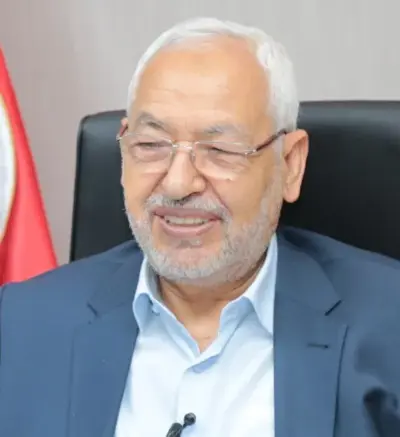
Rached Ghannouchi, also spelled Rachid al-Ghannouchi or Rached el-Ghannouchi, is a Tunisian politician and thinker, co-founder of the Ennahdha Party and serving as its "intellectual leader". He was born Rashad Khriji (راشد الخريجي).
