George C. Marshall Quotes
We Americans treat our army like a mangy old dog.
In the 1930s, led by the conservative Republicans, there was an isolationist subset of our population and the Congress that blocked all efforts to increase defense spending and readiness. The attitude towards the military was terrible. After WWII, the Republicans, realizing the weakness of their earlier political philosophy, flip flopped and went to the other extreme becoming hyper pro-military with little oversight of the needs.
George C. Marshall, 1880-1959, General & U. S. Army Chief of Staff, U. S. Secretary of State, U. S. Secretary of Defense, ~1938, Quoted in Robert E. Sherwood, Roosevelt and Hopkins: An Intimate Portrait
Sourced by: Eigen's Political and Historical Quotations

The Neutrality Acts of the 1930s See {642389} for one of the negative effects of American isolation and the of the Neutrality Acts of the 1930s


This was an official publication of the U. S. Army. The First World War had very little affect on future military preparedness At that time conservatives in Congress were very isolationist and military preparedness was not a high priority or even a significant political issue. The Democrats then were more supportive of military spending than the Republicans. It took World War II, for which America was very unprepared, to produce a change in public and political opinion regarding military preparedness.
The poem was written for and inscribed upon a monument. The Atheists in Foxholes Monument was donated to Alabama Freethought Association, Inc. by the Freedom From Religion Foundation. It is located adjacent to the Willa Mae Whatley Auditorium, in Fearn Park at Lake Hypatia, Alabama.


In contrast to the American army, there was no conscription in Canada. Note the quaint Canadian euphemism, "invited."

The motto was worn on their uniforms which unlike the blue of the rest of the American army was white as can be seen in the famous paining by muralist David R. Wagner. Rhode Island offered freedom to all slaves who would enlist. It not only included Negroes but Indian slaves as well. See {613949} and {614120} for details. The motto itself is interesting in that there was little concept of a country then as most Americans identified themselves as Virginians, New Yorkers or Rhode Islanders. There was no Constitution—only a confederation of States. But the former slaves joining the regiment had never voluntarily associated themselves with Rhode Island, and the first free decision they made was to join the regiment and have a new country.

Mechanics was a general term for people who made things, or fixed things. Ramsay was the first major historian of the American Revolution.


FDR, Eleanor and lost liberals of the time were advocates of a strong military, and unlike after the 2nd Word War, most of the Republicans were conservative isolationists who were opposed to spending much public money for the armed services or weapons.


The Chinese were massacred when the Japanese invaded with atrocities against civilians that were inconceivable until Hitler began his in Europe. However, there were many Chinese we worked against the Japanese including the Communists who made a truce with Chiang (see {636322}) so that they could oust the Japanese invaders.


3rd Earl Russell of Kingston
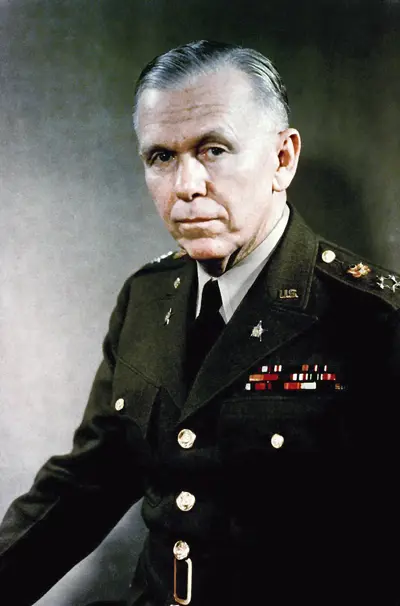
- Born: December 31, 1880
- Died: October 16, 1959
- Nationality: American
- Profession: Soldier
George Catlett Marshall Jr. was an American soldier and statesman. He rose through the United States Army to become Chief of Staff under presidents Franklin D. Roosevelt and Harry S. Truman, then served as Secretary of State and Secretary of Defense under Truman. Winston Churchill lauded Marshall as the "organizer of victory" for his leadership of the Allied victory in World War II. After the war, he spent a frustrating year trying and failing to avoid the impending civil war in China. As Secretary of State, Marshall advocated a U.S. economic and political commitment to post-war European recovery, including the Marshall Plan that bore his name. In recognition of this work, he was awarded the Nobel Peace Prize in 1953.
