Sam Hughes Quotes
Every man among you is a free will volunteer. Not one has been invited. No more typical are made of free man who ever marched to meet an enemy.
In contrast to the American army, there was no conscription in Canada. Note the quaint Canadian euphemism, "invited."
Sam Hughes, 1853-1921, Canadian Minister of Militia and Defense, Speech to Canadian troops during the First World War
Sourced by: Eigen's Political and Historical Quotations


Westmoreland’s critics point to this quotation as an illustration of exactly why he was the wrong man for the job. As Vietnam Supreme Commander, he controlled more firepower than any other military leader in history and yet he had “no room” for thought or reason much less mercy. Subsequent commanders of U. S. military efforts were much more sophisticated like, Colin Powell, Norman Schwarzkopf, and Wesley Clark who were leading American thinkers, sophisticated at political and military reasoning and very capable of mercy. The modern American military requires men and women who are skilled at thinking and reasoning.

The poem was written for and inscribed upon a monument. The Atheists in Foxholes Monument was donated to Alabama Freethought Association, Inc. by the Freedom From Religion Foundation. It is located adjacent to the Willa Mae Whatley Auditorium, in Fearn Park at Lake Hypatia, Alabama.

The Shakers were an American religion and pacifists Lincoln learned. He was so impressed with their sincerity and way of life that he exempted Shaker men from the draft—the first conscientious objectors formally recognized in America. However, Lincoln made the statement to the Shakers which greatly impressed them and caused much reflection. Quakers had been pacifists also, but until the Civil War Draft there was no mechanism to test.

The American Army had just liberated Bellau Wood, but had lost almost 8,000 men.

“Volk” loosely translated means “the people.” However it carries the connotation of a unity that “the people” does not.


Public opinion in the Union was quite different and more complex. Eggleston was an accomplished writer who had served in the Confederate army of the Civil War. 20 year after the war he wrote a series of articles for the prestigious Northern Atlantic Monthly trying to convey the war from the Southerner’s point of view.

This quotation is a wonderful illustration of the change that has taken place in the American military. The young man who was not skilled enough for anything else was meant to be a soldier. By 2010 only one in four high school graduates would be skilled and intelligent to be qualified for the Untied States Navy. The other services also had high requirements in order to function with the high technology, of the modern military.
While Mangin was disgustingly racist, many native soldiers from Senegal, Morocco and other French colonies were pleased that Mangin was not only advocating that they serve with the French Army, but the General was critical of the fighting spirt of the then contemporary Frenchmen and claimed that the “prmitives” would invigorate the French Army. Mangin’s view was adopted as policy and in the First World War, native colonial troops were an important component of the victorious French Army.

He was leading the Gordon Highlanders of the British Army against the Boers during the Boer War. He was seriously wounded and could not go on himself with a charge he had ordered, However, waifing his sword he made this famous qutation. Particualrly noteorthy is the derrogatory terms which he used to describe the enemy--the Boers of South Africa. In many wars and cultures, one or more of the combatants, in order to overcome the avarage soldier's reluctance to kill an enemy, characterizes them as less than human. In this case, vermin, who were to be exterminated. There were two predominant groups of whites who came to South Africa, the English who were generally well-educated and were interested in trading with the exhisting inhabitants and investing in businesses using mostly native labot and the Boers. The latter were of Dutch and German origin, poor farmers with little or no land in the home country and little education. Their interest was to create a nation where they could own land to farm. And the lest expensive way for them to increase their farmland was to sieze it from the native Blacks and who were the major forces behind the racial discrimination which became apartheid. The British contolled the government and sought stability and as in most of the British Empire, they wanted English law to prevail including the rights of the Black natives. The Boers had left Europe for good and would thrive or not in Southern Africa. Proportiopnately, the English might have a career in South Africa or serve there for a few years. They were Englishmen in a foreign country. The Boers saw themselves as citizens of Southern Africa who were fighting the native Blacks for control of the land. The English legal system would not allow any of the land seizures and political discrimination that the Boers saw as existential for their survival in Africa. Soon, the Boers took more and more of the law into their own hands and saw English rule and dmination as inimical to their interests in Africa and they tried to create their own independent states in Southern Africa. That was the essense of the Boer Wars. Dick-Cunyngham was awarded the Victoria Cross, the highest military decoration of Great Britain, for his exploits in the Afghan War.

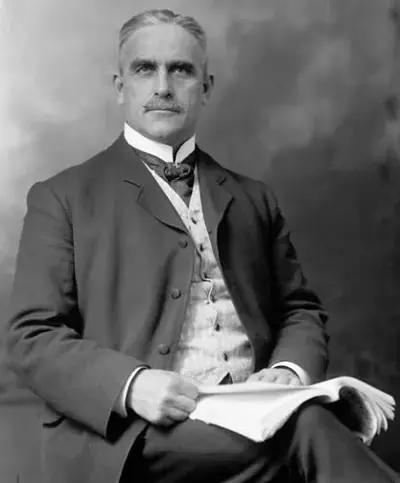
Sir Samuel Hughes, KCB PC was the Canadian Minister of Militia and Defence during World War I. He was notable for being the last Liberal-Conservative cabinet minister, until he was dismissed from his cabinet post.
