Oliver Perry Morton Quotes
waving the bloody shirt
Oliver Perry Morton, 1823-1877, U. S. Senator (Republican, IN), Governor of Indiana, Phrase he used to describe a Northern style of campaigning after the Civil War where the candidate castigated the Democrats for having started the war and killed patriotic Americans and asked the voters to relive the Civil war
Sourced by: Eigen's Political and Historical Quotations


In 2012, the Republican party had shifted to the right and was split between two factions. None of the 4 leading candidates had the support of a majority of the activist Republicans who vote in Primary elections. The then started to vie with each other for the most conservative elements of the party and did so by attacking the other candidates, making moral pronouncements and attacking President Obama. None of them offered any positive programs or solutions to the problems they claimed existed, and the attacks on the others were always that they were “really not conservative” and “could not get elected.” The result was that all the candidates negatives rose.


The text was actually written by John Kenneth Galbraith who was writing speeches for Stevenson.

Accusing a candidate who opposed a particular war effort as a traitor and collaborator with the enemy in a campaign worked very well in the 2004 Presidential race where the Republicans painted John Kerry, a war hero, as a traitor and collaborator for opposing the Vietnam War. However, the Republicans had learned the dirty trick in middle of the 19th century from the Democrats when Stephen Douglas accused Abraham Lincoln of selling out his country because Lincoln had opposed the Mexican War. Just as Kerry lost, so did Lincoln in this Senate race, but Lincoln better armed to deal with the attacks, ran for the Presidency two years later.

It is surprising that this long after the Civil War had ended, there was a select Congressional Committee for dealing with matters involving the Confederate States. Note the quaint language that was used.


Ingersoll was considered to be the greatest orator and political thinker of his day, but his overt atheistic views curtailed his elected political career.

Referring to the political emphasis on family values:

The last lines of the editorial were tragically accurate in predicting the Civil War. The more the slavery question was debated in the nation, the more polarized the country became. If the South would persist in trying to curtail men’s freedom and maintain slavery, the slaves had the same right of revolution and insurrection as was established in the American Revolution. That was the view of most abolitionists. Southern slave holders, feared an armed slave rebellion more than anything else, and observed that debating the issue of slavery was just riling up Blacks and whites and would instigate such armed revolutions. The Southern solution was to cease debating the slavery question. The Northern solution was to end slavery. Neither side would accept the solution of the other and the Civil War ensued.

“Waving the bloody shirt” was a term that some Southerners accused Northern post Civil War politicians of inflaming Northern public opinion by relating incidents of Northerners who wanted to help uphold the equal rights of Blacks in the South and were murdered by the Klu Klux Klan and waving a bloodstained shirt belonging to the dead martyr. There never was an incident that could be documented of actually waving a bloody shirt. But many Northern politicians related events of Southern lynchings and other assaults on Blacks and Whites who were guilty of nothing but claiming lawful rights for Negroes. Northerners who remembered the Civil War and the atrocities and war crimes of Andersonville and Quantrill’s Raiders when they heard these speeches were outraged and angry. This created much anti-Southern attitudes in the North and the West some of which exist to this day.
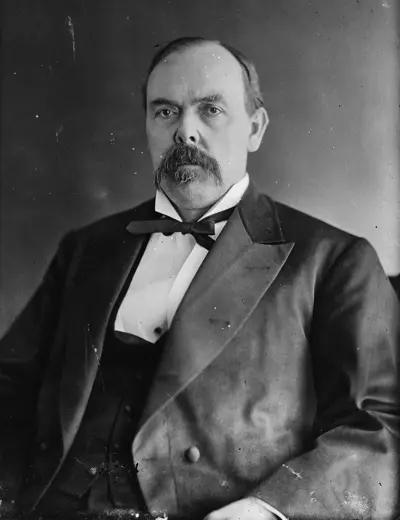
Oliver Hazard Perry Throck Morton, commonly known as Oliver P. Morton, was a U.S. Republican Party politician from Indiana. He served as the 14th Governor (the first native-born) of Indiana during the American Civil War, and was a stalwart ally of President Abraham Lincoln. During the war, Morton thwarted and neutralized the Democratic-controlled Indiana General Assembly. He exceeded his constitutional authority by calling out the militia without approval, and during the period of legislative suppression he privately financed the state government through unapproved federal and private loans. He was criticized for arresting and detaining political enemies and suspected southern sympathizers. As one of President Lincoln's "war governors", Morton made significant contributions to the war effort, more than any other man in the state, and earned the lifelong gratitude of former Union soldiers for his support.
