Rutherford B. Hayes Quotes
[McKinley] is on a stumping tour ... I criticized the bloody-shirt course of the canvass [campaign]. It seems to me it is bad "politics," and of no use.... An increasing number of people are interested in good relations with the South.
“Waving the bloody shirt” was a term that some Southerners accused Northern post Civil War politicians of inflaming Northern public opinion by relating incidents of Northerners who wanted to help uphold the equal rights of Blacks in the South and were murdered by the Klu Klux Klan and waving a bloodstained shirt belonging to the dead martyr. There never was an incident that could be documented of actually waving a bloody shirt. But many Northern politicians related events of Southern lynchings and other assaults on Blacks and Whites who were guilty of nothing but claiming lawful rights for Negroes. Northerners who remembered the Civil War and the atrocities and war crimes of Andersonville and Quantrill’s Raiders when they heard these speeches were outraged and angry. This created much anti-Southern attitudes in the North and the West some of which exist to this day.
Rutherford B. Hayes, 1822-1893, 19th President of the United States (Republican, OH), Diary, September 11, 1885
Sourced by: Eigen's Political and Historical Quotations


The stranglehold that the Southern Democrats had held on civil rights legislation had been broken in 1968 by Lyndon Johnson and the other Democrats with key support from some liberal Republicans like Lindsay. However, the South felt politically betrayed. The Republican leadership, in what was one of the most brilliant political strategies in American history, played to the disaffected racist Southerners and welcomed into their party. Within the next 30 years virtually the entire South had gone Republican, and the Republican captured both houses of Congress and the Presidency with the South solidly Republican. At the time, Lindsay and some Republican leaders criticized bitterly about the party pandering to the worst racist elements of the nation. The “Party of Lincoln” had become the party of the segregationists, the racists, the hate groups of the country.


See Mark {606304}; also Matthew {606727}. Lincoln had used the “house divided” biblical metaphor in 1843 when arguing for Whig solidarity. The first political use of the Biblical metaphor and quotation with respect to American slavery appears to have been by Sam Houston in 1850 {603970}. The first use with respect to American slavery was byMassachusetts abolitionist, Edmund Quincy, in 1852. The second sentence of this famous quotation was forsaged earlier. See Lincoln, {619494} & {584918}. Also See Felix Rohatyn who used the Lincoln line to refer to poverty: {70611}.

He was a speechwriter for Adlai Stevenson who wrote many of his own speeches but so many are required a modern president and candidate must have speechwriters.


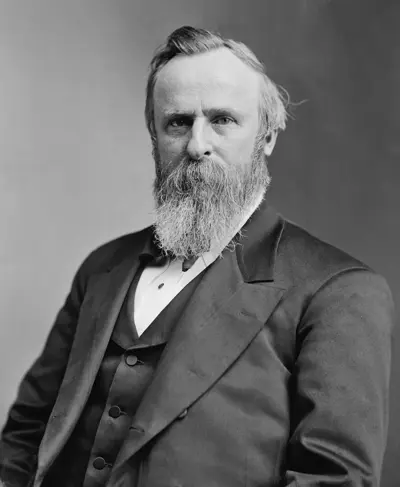
Rutherford Birchard Hayes was an American politician and attorney who served as the 19th president of the United States from 1877 to 1881, after serving in the U.S. House of Representatives and as governor of Ohio. A lawyer and staunch abolitionist, he had defended refugee slaves in court proceedings during the antebellum years. He negotiated the political agreement to end federal support of Reconstruction.
