John Kenneth Galbraith Quotes
There is not alternative to speechwriters. You can’t run for president and write your own speeches.
He was a speechwriter for Adlai Stevenson who wrote many of his own speeches but so many are required a modern president and candidate must have speechwriters.
John Kenneth Galbraith, 1908–2006, Economist, U. S. Ambassador to India (Democrat), C-SPAN Interview with Brian Lamb, September 23, 1994
Sourced by: Eigen's Political and Historical Quotations


Adlai Stevenson had just finished a particularly good speech at the University of Texas.

Dr. Sovern played Ronald Regan in the debate preparation of Walter Mondale

This is a wonderful historical picture of FDR on his campaign train. Note that the President liked to listen to ideas of many people. Unlike most Presidents he did not have any particular political programs that he advocated in his campaigning. He had no immediate answers to the Great Depression that he had inherited from the Hoover administration. But unlike Hoover, and most Presidents, he was willing to try ideas for which there was no advance evidence of success. If that did not help, he would try something else. He sought ideas from anyone and everyone. His enemies called him a weak leader who had no ideology—no principles but just trying unproven solutions to solve the nation’s critical problems. But it worked and he was elected 4 times—the only President who had served even 3 terms.

At that moment Hoover was the first politician to ever use the then new technology of a Teleprompter. Hoover was video recording a political speech for the Republican Convention. The teleprompter operator had not kept up with his pace of the speech, and with no protocols or other procedures, this quotation is what Hoover said. Hoover, a great engineer before politics was always interested in new technology. When Secretary of Commerce, he was the first politician ever to appear on television.


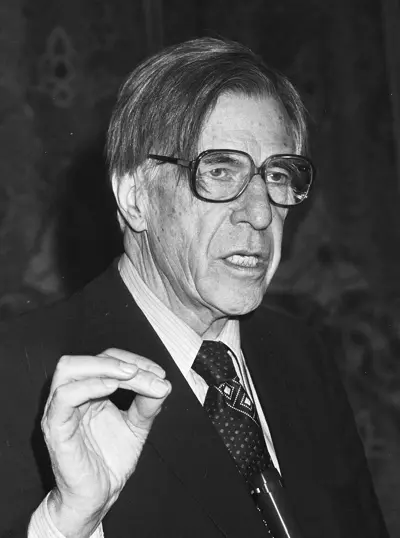
John Kenneth Galbraith OC, also known as Ken Galbraith, was a Canadian-American economist, diplomat, public official and intellectual. A leading proponent of 20th-century American liberalism, his books on economic topics were bestsellers from the 1950s through the 2000s. As an economist, he leaned toward post-Keynesian economics from an institutionalist perspective.
