John Lindsay Quotes
We see political leaders replacing moral imperatives with a Southern strategy.
The stranglehold that the Southern Democrats had held on civil rights legislation had been broken in 1968 by Lyndon Johnson and the other Democrats with key support from some liberal Republicans like Lindsay. However, the South felt politically betrayed. The Republican leadership, in what was one of the most brilliant political strategies in American history, played to the disaffected racist Southerners and welcomed into their party. Within the next 30 years virtually the entire South had gone Republican, and the Republican captured both houses of Congress and the Presidency with the South solidly Republican. At the time, Lindsay and some Republican leaders criticized bitterly about the party pandering to the worst racist elements of the nation. The “Party of Lincoln” had become the party of the segregationists, the racists, the hate groups of the country.
John Lindsay, 1921-2000, New York Mayor (Republican), Speech at The University of California, Berkeley, April 2, 1970
Sourced by: Eigen's Political and Historical Quotations


The Republicans had been badly beaten in the 2012 Presidential Election. Many attributed the loss to the dissatisfaction of the electorate with the Republican ideas which had become more and more conservative in recent decades. Others, like Rubio, wanted to maintain the existing ideas which were very different from the Republican ideas earlier when they won more elections.

This was art of the Nixon "Southern Strategy" to alienate the white supremacists and racists from the Democratic Party with Civil Rights legislation and rhetoric, and get most of them to become Republicans. But as Phillips observed, when Negroes began voting in significant numbers in the South the party switching really accelerated.


This was a new political phenomenon where a President was perceived as more important, more powerful, and preferable to his party. Note that the base of the scale is labeled “Public Opinion”.


Moses urged them not to accept a compromise what would give them the majority of everything that they were demanding but not all. See {637624} for Rustin’s’ argument to accept the compromise.
The 1963 Civil Rights Bill passage infuriated the Southern Racists, and the Republicans invited them to switch parties in revenge and by 1990 the shift was almost total.


Goldwater was not a racist personally, however he opposed the Civil Rights Bill of 1964 against the leadership and majority of the Republican Party, and he initiated a “Southern Strategy” whereby he invited the racists of the South who were furious that Democrat Lyndon Johnson had abandoned them and ended legal segregation forever, to leave the Democratic Party. They did, and while they and the hard core of ultraconservative Goldwater republicans were not enough to overcome the public disapproval of the callous strategy and Goldwater’s nuclear positions. However, the coalition that Goldwater had assembled formed the base of a new Republican Party which gave Ronald Reagan strong majorities, and in the early 21st century the Goldwater coalition of Southerners, Goldwater conservatives gained control of the Republican Party and purged most of the moderates and polarized American politics ending even the traditional bipartisanship in Foreign Affairs.

He was discussing how to move the Republican Party to the extreme right. on a 2010 interview with Political Vindication Radio, and extreme California Radio Talk Show. Six years later he became Donald Trump’s Campaign CEO and after Trump won, he became the President’s Chief Policy Advisor. He was much closer to “taking it over”—the Republican Party.


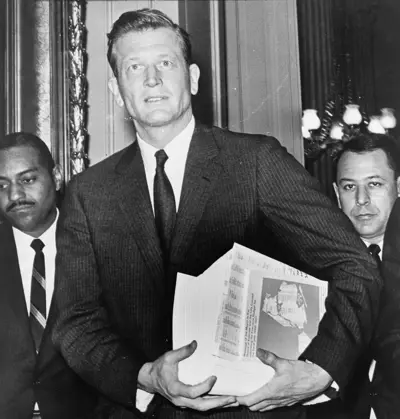
John Vliet Lindsay was an American politician and lawyer. During his political career, Lindsay was a U.S. congressman, mayor of New York City, and candidate for U.S. president. He was also a regular guest host of Good Morning America. Lindsay served as a member of the United States House of Representatives from January 1959 to December 1965 and as mayor of New York City from January 1966 to December 1973. He switched from the Republican to the Democratic Party in 1971, and launched a brief and unsuccessful bid for the 1972 Democratic presidential nomination as well as the 1980 Democratic nomination for Senator from New York. He died from Parkinson's disease and pneumonia in Hilton Head Island, South Carolina on December 19, 2000.
