Mahatma Gandhi Quotes
Today the cities dominate and drain the villages so that they are crumbling to ruin.
Gandhi, Mahatma. Harijan, Harijan Sevak Sangh, 28 Jan. 1939, p. 438.


Spengler and some others viewed with alarm the urban migration that had come with the industrial revolution. That migration was relatively minor compared to what took place in the remainder of the 20th century. In most developed coutries the rural population has become very small and the urban and suburban totally dominant.

Western populists were terribly suspicious of the cities. Note that the migration to cities was noticeable enough to be considered a problem. Better roads and the railroads made relocation easier.


Howard was one of the first people to recognize the migration from the country to the cities brought about by the Industrial Revolution and then suggest solutions. He advocated planned suburban communities that had some elements of the country, but allowed a density of people to function in an industrial economy. He called them “Garden Cities”. Forest Hills in New York and other American planned communities were much influenced by his thinking as were many other new communities since.


Roman citizenship had been reserved only for Romans. However, when Caesar spend extended time in Cleopatra’s Alexandria, he saw the effect of having a great center of learning in a city. It not only improved the quality of life, but the economic effect was profound as even though Rome was the most powerful Empire of the world, Alexandria was much larger, wealthier, and better developed. It was an effect not unlike that of a great university made throughout Europe later and America today. The scholars and intellectuals in sufficient numbers acted like a modern incubator.


The problem she described has generally not been solved. The only thing that saved most of rural America is the remarkable increase in agricultural productivity, but that has become so good that farming requires fewer and fewer workers each year and migration to the cities has continued since before WWII. However to avoid higher city wages, unionization, higher taxes, and higher energy costs, many industrial operations deliberately moved to small or medium sized after WWII, and many communities then became one company towns. Then the companies would relocate elsewhere if the mover would save some costs, and the small towns who did get factories were again in the predicament that Mrs. Roosevelt describes. In the 1980s, off shoring eliminated the major job source for thousands of small towns and cities as well. Some cities and suburban areas attracted knowledge industry companies and jobs, but the small town problem is in much of America just as it was when Mrs. Roosevelt wrote this in her column in 1936.


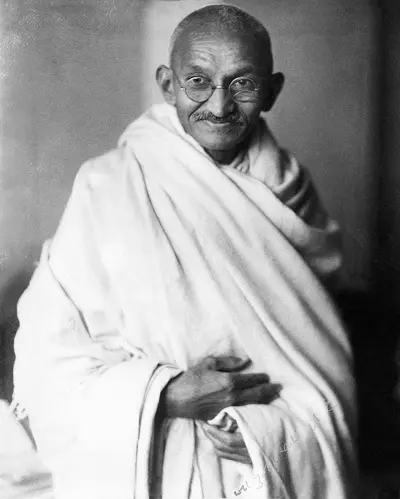
Mohandas Karamchand Gandhi was an Indian lawyer, anti-colonial nationalist, and political ethicist, who employed nonviolent resistance to lead the successful campaign for India's independence from British rule, and in turn inspired movements for civil rights and freedom across the world. The honorific Mahātmā (Sanskrit: "great-souled", "venerable"), first applied to him in 1914 in South Africa, is now used throughout the world.
