Constantine I Quotes
To all who entertain just and sound sentiments respecting the character of the Supreme Being, it has long been most clearly evident, and beyond the possibility of doubt, how vast a difference there has ever been between those who maintain a careful observance of the hallowed duties of the Christian religion, and those who treat this religion with hostility or contempt. But at this present time, we may see by stilt more manifest proofs, and still more decisive instances, both how unreasonable it were to question this truth, and how mighty is the power of the Supreme God: since it appears that they who faithfully observe His holy laws, and shrink from the transgression of His commandments, are rewarded with abundant blessings, and are endued with well- grounded hope as well as ample power for the accomplishment of their undertakings. On the other hand, they who have cherished impious sentiments have experienced results corresponding to their evil choice. For how is it to be expected that any blessing would be obtained by one who neither desired to acknowledge nor duly to worship that God who is the source of all blessing? Indeed, facts themselves are a confirmation of what I say.
Constantine I, 280-337, Constantine the Great, Roman Emperor, Message to the People of Palestine
Sourced by: Eigen's Political and Historical Quotations

Madison was a deist, but was firm that religion was to be an individual matter and not an area in which the state ought be involced.

Hizb ut-Tahrir is a “worldwide Islamic political party.” It is banned as a terrorist, violence provoking institution in most of the Muslim countries and many nations in Europe.


See John Leland for opposition to this clause: {608955}

Philip II, by this statement, and his subsequent behavior, made a major step forward in France for the separation of church and state. Previously, French kings played a major part in the selection of the bishops and other high clerics of the realm. Phillip ceased that type of interference. He did however, close down a religious commune for misbehavior, but that was at the request of both the church and civil authorities. See {617074} . The religious authorities at the time were delighted with this form of separation of church and state, but they were adamant that their church should be able to influence the monarchy and laws of the realm. In contrast today, the Chinese government does not allow any religion to interfere with the operation of the government, but insists that the Dali Lama and the Bishops of the Catholic church can only be appointed with their approval. Separation of church and state is a two way phenomenon.

Also inscribed in gold around the Dome of the Rock. This was the most overt statement against Christianity and the Trinity in the Koran.


Judge Moore was trying to justify oaths to God or other state references to a Judeo-Christian God as not violating the 1st Amendment stricture about the government endorsing a particular religion. Note however his {33827} quotation.
Some modern Islamic scholars have attempted to make this Sura more acceptable by arguing that the size of the stick with which the man may beat the “disobedient” wife should be limited. The contemporary argument concentrates on the size of the stick. There are also a few fundamentalist Christians who advocate the right of a husband to beat his wife on the grounds that this was accepted in Biblical times.


This verse is often cited by Muslim scholars who are defending against the claim that The Koran teaches violence against non-Muslims. In this case, the Jews are admonished to kill their defeated enemies. Today many Muslims claim that Jews and Christians who believe in the Old Testament believe that the violence was justified because it was ordered by God. Therefore when God orders Muslims to kill idolaters and other enemies, it is the same thing and not reprehensible.


Some other Republican governors thought that Fordice had misspoken and offered him a chance to correct or modify his statement. He declined.


by the House of Saud


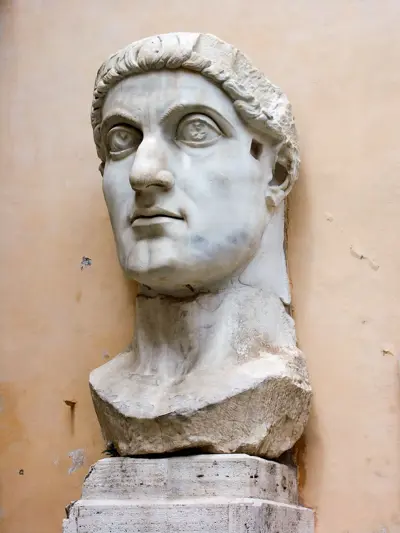
Constantine I, also known as Constantine the Great, was a Roman emperor from 306 to 337. Born in Naissus, Dacia Mediterranea (now Niš, Serbia), he was the son of Flavius Constantius, a Roman army officer born in Dardania who became one of the four emperors of the Tetrarchy. His mother, Helena, was Greek and of low birth. Constantine served with distinction under emperors Diocletian and Galerius campaigning in the eastern provinces against barbarians and the Persians, before being recalled west in 305 to fight under his father in Britain. After his father's death in 306, Constantine was acclaimed as emperor by the army at Eboracum (York). He emerged victorious in the civil wars against emperors Maxentius and Licinius to become sole ruler of the Roman Empire by 324.
