Henry Ford Quotes
Thus may be envisioned a United States of the World. Ultimately, it will surely come.
Henry Ford, 1863-1947, Industrialist & Philanthropist, Unsuccessful Republican Michigan U. S. Senatorial Candidate [1918], My Philosophy of Industry, 1929
Sourced by: Eigen's Political and Historical Quotations


Historically, this quotation seems like an endorsement of motherhood, but it was an extremely important statement at the time. Eisenhower was convinced to run for the Presidency as a Republican in order to stop Senator Robert Taft and the conservative, isolationist, right wing of the Republican Party. These Republicans opposed American support of the United Nations. Eisenhower won the Republican nomination, then the general election, and clearly announced to the country and the world, that the moderate wing of the Republican Party was in control and the United Nations was an important part of our foreign policy.


When he made this statement, the United States was the only nation that had the atomic bomb, but he and other leading nuclear scientists realized that it would not be long before the Russians would also have nuclear weapons, and other countries would so follow suit. He and some others saw a world government as the best way to cope with the nuclear proliferation problems. However, there was too much diversity of values and political ideology in the world to be accommodated in a single government, and the United Nations was the only thing that was practical and that was far from a government and had virtually no sovereignty. However, during the Cold War, Russia and the United States agreed on a Nuclear Proliferation Treaty and most nations of the world, agreed, so that for the issue of nuclear proliferation, the world had a type or world government—an international treaty. However, India and Pakistan did not adhere to it and developed nuclear weapons and North Korea was never a signatory. Other countries like Iran began to evade the treaty and since there was no real world government it was difficult to enforce the treaty throughout the world.


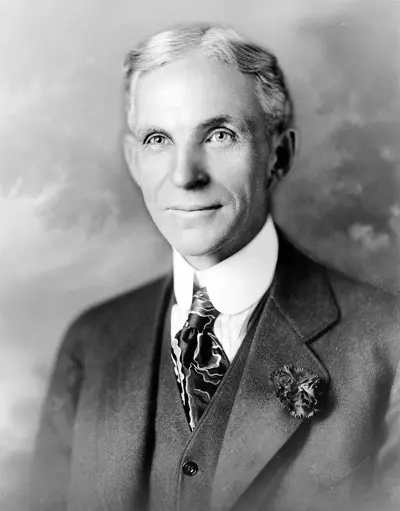
Henry Ford was an American industrialist, business magnate, anti-Semite, and founder of the Ford Motor Company and chief developer of the assembly line technique of mass production. By creating the first automobile that middle-class Americans could afford, he converted the automobile from an expensive curiosity into an accessible conveyance that profoundly impacted the landscape of the 20th century.
