Albert Einstein Quotes
A world authority and an eventual world state are not just desirable in the name of brotherhood, they are necessary for survival.
Albert Einstein, 1879-1955, Nobel Laureate in Physics, 1946
Sourced by: Eigen's Political and Historical Quotations


This was the first time a Cabinet Member had ever addressed Congress. He had just concluded an alliance with Soviet Russia for fighting Hitler and Japan in the Second World War. Some were uneasy about an alliance with the Communist state. However, the Congress approved overwhelmingly.
When he made this statement, the United States was the only nation that had the atomic bomb, but he and other leading nuclear scientists realized that it would not be long before the Russians would also have nuclear weapons, and other countries would so follow suit. He and some others saw a world government as the best way to cope with the nuclear proliferation problems. However, there was too much diversity of values and political ideology in the world to be accommodated in a single government, and the United Nations was the only thing that was practical and that was far from a government and had virtually no sovereignty. However, during the Cold War, Russia and the United States agreed on a Nuclear Proliferation Treaty and most nations of the world, agreed, so that for the issue of nuclear proliferation, the world had a type or world government—an international treaty. However, India and Pakistan did not adhere to it and developed nuclear weapons and North Korea was never a signatory. Other countries like Iran began to evade the treaty and since there was no real world government it was difficult to enforce the treaty throughout the world.


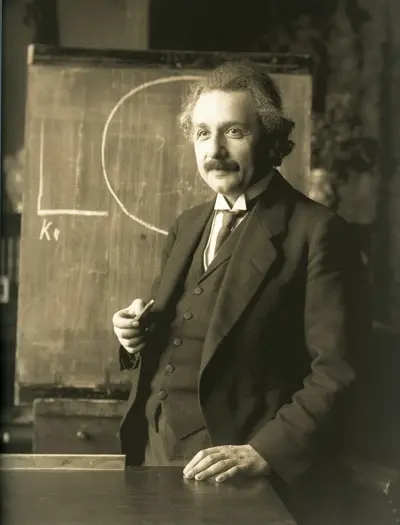
Albert Einstein was a German-born theoretical physicist, widely acknowledged to be one of the greatest physicists of all time. Einstein is known for developing the theory of relativity, but he also made important contributions to the development of the theory of quantum mechanics. Relativity and quantum mechanics are together the two pillars of modern physics. His mass–energy equivalence formula E = mc2, which arises from relativity theory, has been dubbed "the world's most famous equation". His work is also known for its influence on the philosophy of science. He received the 1921 Nobel Prize in Physics "for his services to theoretical physics, and especially for his discovery of the law of the photoelectric effect", a pivotal step in the development of quantum theory. His intellectual achievements and originality resulted in "Einstein" becoming synonymous with "genius".
