Ralph Bunche Quotes
The United Nations is our one great hope for a peaceful and free world.
Bunche, Ralph. "Acceptance Speech." Nobel Lectures, Peace 1926-1950, edited by Frederick W. Haberman, Elsevier Publishing Company, 1972.


Historically, this quotation seems like an endorsement of motherhood, but it was an extremely important statement at the time. Eisenhower was convinced to run for the Presidency as a Republican in order to stop Senator Robert Taft and the conservative, isolationist, right wing of the Republican Party. These Republicans opposed American support of the United Nations. Eisenhower won the Republican nomination, then the general election, and clearly announced to the country and the world, that the moderate wing of the Republican Party was in control and the United Nations was an important part of our foreign policy.


When he made this statement, the United States was the only nation that had the atomic bomb, but he and other leading nuclear scientists realized that it would not be long before the Russians would also have nuclear weapons, and other countries would so follow suit. He and some others saw a world government as the best way to cope with the nuclear proliferation problems. However, there was too much diversity of values and political ideology in the world to be accommodated in a single government, and the United Nations was the only thing that was practical and that was far from a government and had virtually no sovereignty. However, during the Cold War, Russia and the United States agreed on a Nuclear Proliferation Treaty and most nations of the world, agreed, so that for the issue of nuclear proliferation, the world had a type or world government—an international treaty. However, India and Pakistan did not adhere to it and developed nuclear weapons and North Korea was never a signatory. Other countries like Iran began to evade the treaty and since there was no real world government it was difficult to enforce the treaty throughout the world.


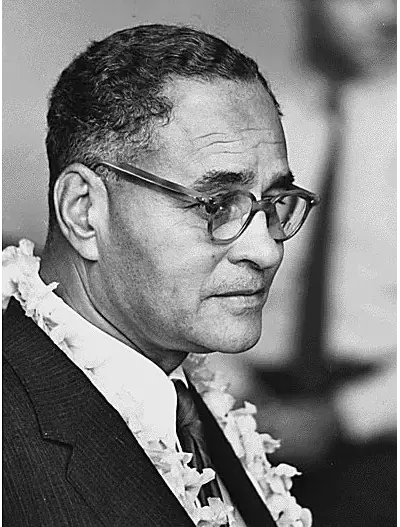
Ralph Johnson Bunche was an American political scientist, diplomat, and leading actor in the mid-20th Century decolonization process and US civil rights movement, who received the 1950 Nobel Peace Prize for his late 1940s mediation in Israel. In the List of black Nobel laureates he is the first African American and first person of African descent to be awarded a Nobel Prize. He was involved in the formation and administration of the United Nations and played a major role in both the decolonization process and numerous peacekeeping operations sponsored by the UN. In 1963, he was awarded the Presidential Medal of Freedom by President John F. Kennedy. At the UN, Bunche gained such fame that Ebony magazine proclaimed him perhaps the most influential African American of the first half of the 20th Century and "[f]or nearly a decade, he was the most celebrated African American of his time both [in the US] and abroad."
