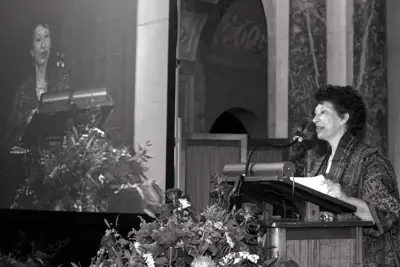
Fatima Mernissi Quotes
Throughout its history Islam has been marked by two trends: an intellectual trend that speculated on the philosophical foundations of the world and humanity, and another trend that turned political challenge violent by resort to force.
Fatima Mernissi, Moroccan Sociologist, Quoted in Benjamin R. Barber, Jihad Vs. McWorld
Sourced by: Eigen's Political and Historical Quotations


6th Baron Byron. This is one the earliest references to the ultra-fundamentalist Wahhabi Islamic sect which dominated Saudi Arabia Islam in the late 20th and early 21st century and which inspired terrorism against the West and Israel. When Byron wrote this canto the sect was just a decade old and had already taken over Mecca by violence. Byron was prophetic.

The notion that Islam would be practiced by individuals was in the Ayatollah’s view insufficient. Islam must also control the government—the head.


His views are a mix of modernism and fundamentalism. He favors democracy and elections but also favored the Taliban destroying the great ancient Buddha statues when he was called an idol worshipper for urging the preservation of art.


The reason he claimed that Governor Taseer was a blasphemer was that the governor opposed death penalty for saying or writing anything that was heresy or blasphemy as interpreted be fundamentalist Muslims. The Governor knew he was taking a risk. See {620970} .

Voltaire had little respect for any organized religion, but found Islam particularly barbaric and absurd. However he was also very negative about Christianity. See {621191} . The Ottoman Empire, centered in Turkey, then controlled all the Islamic countries of the Middle East. Europeans then often referred to all Muslims as “Turks.”


Bangladesh had fared very poorly as a part of Pakistan. When it revolted and became independent, it adopted a secular government whereas Pakistan had been, and is, a heavily Islamic state. However, the vast majority of Bengalis were Muslim and some were extreme fundamentalists. Rahman was under constant pressure to make the government more “Islamic” and while he did so somewhat, he tried to advocate for separation of church and state. Bangladesh is not as extreme as Pakistan which is not yet a theocracy but religious forces dominate every aspect of the society.
The writer was born and brought up a Muslim and because he criticizes Islam, he has had a death fatwa issued against him much like Salman Rushdie. His prediction was one of the earliest warnings


The key security organizations of the Pakistan government had large numbers of radical Islamicists with great sympathy and close ties with the Islamic terrorists.
Legal Religious Ruling. This is an example of a source of tension between some Muslims and others. Non-Muslims are required to have a Muslim Education in Muslim countries, but they insist that any required Christian or secular education in a non Muslim country is anti-Islamic.


This quotation illustrated the extreme polarization between the current fundamentalist Muslims, and the Muslim modernists and the West. Kamal Ataturk, the great leader and stateman who is the father of modern Turkey, is castigated by the author for leading the new Turkish parliament to depose the Caliph – the civil and religious autocrat, one of whom reigned from after the death of Muhammad till his abolishment in 1924. Most of the rest of the world credits Ataturk with being one of the great leaders of all time—one who led a democratic revolution which transformed Turkey into the only Muslim secular democracy, requiring pubic secular European type education for all children, giving women the right to vote (before the U. S. even), adopting a European alphabet and dress, and outlook on life—creating most remarkably a total cultural revolution with virtually no loss of life. No revolutionary leader, before or since has led so extensive a political and cultural revolution, and it was a bloodless revolution. Turkey, into the 21st century, was by far the most powerful, industrialized, scientific and modern nation of Muslims in the world and others were far behind. Yet many Islamic theologian still castigate Atatork for his great achievements as being against the will of God.