Baruch Spinoza Quotes
This I know, that between finite and infinite there is no comparison; so that the difference between God and the greatest and most excellent created thing is no less than the difference between God and the least created thing.
This view, which is corresponds to must medern religions but not all, was not held by Christians, Jews or Muslims of his day. Those who appeard superior were assumed to be closer to and favored by God. Spinoza’s ideas were considered so radical and dangerous that he was the only man in history who was excommunicated by the Catholics, the Jews and the Muslims.
Benedict Spinoza, Letter to Hugo Boxel, October 1674
Sourced by: Eigen's Political and Historical Quotations

Diversarum Hereseon Liber. This compendium of heresies would be funny but for the fact that people lived and died according to their “acceptance” of some of these absurdities.


This quotation is an example of how even sophisticated institutions and leaders were plagued by various stereotypes. Dean Sperry as well as many other members of the clergy actually believed that women would not go to divinity school because they were interested in the theology but because they were looking to marry a minister. When the dean told the trustees that he had “no wisdom on this matter” is was one of the great understatements in the history of quotations. What is more ironic is that the Dean was considered very liberal having admitted Catholics, Nazarenes, and Adventists.
His protest was focused on Middle East policies which he believed did not value the lives of Muslims as highly as Christians and Jews. The irony of this protest is that United States policy claims to value all life equally as do virtually all industrialized democracies. Omeish however is unusual among world Islamic leaders and politicians in that he values Christian and Jewish life as much as Muslim. Most, typically value Muslims almost exclusively and many advocate the killing of Christians and Jews.

Judge Moore was trying to justify oaths to God or other state references to a Judeo-Christian God as not violating the 1st Amendment stricture about the government endorsing a particular religion. Note however his {33827} quotation.

Spinoza’s ideas were considered so radical and dangerous that he was, perhaps, the only man in history who was excommunicated by the Catholics, the Jews, and the Muslims.


presently in Israel. The document purports to represent the views of the Ottoman Sultan of the time. Napoleon Bonaparte had launched an invasion of the Middle East bring foreign troops and foreign new ideas. The Governor led military and propaganda opposition to the French and fortified Acre and withstood Napoleon’s siege of 1799.

Some modern Islamic scholars have attempted to make this Sura more acceptable by arguing that the size of the stick with which the man may beat the “disobedient” wife should be limited. The contemporary argument concentrates on the size of the stick. There are also a few fundamentalist Christians who advocate the right of a husband to beat his wife on the grounds that this was accepted in Biblical times.

Kneeling next to a black slave at a church alter:

Early Christianity had a wide diversity of sect and opinion.
Husayn Ali Nuri. The equality of women which he proclaimed was another threat to Islam of which Bahai was a reform offshoot. Even in modern times in Iran, many Bahai are hunted down and executed.
This sura has justified major discrimination against non-Muslims so that they should never appear “preeminent” over the faithful. See for example, {617157} and {617160}.

In one of the earliest claims that women should be allowed to preach, she made a theological argument and then challenged the male theologians to better her arguments. Although she was very demur, intellectually and theologically she “took it right at them.” Such intellectual aggression by women was virtually unheard of.
The speaking to which she was referring was Christian Religious preaching by women. At the time it was considered by most Christians to be sacrilegious for women to preach. This came down from the orthodox Jewish tradition, and there are several passages in the New Testament where the Apostles, who were Jews themselves were echoing the religious tradition. This then took on a meaning that went beyond tradition as in Judaism. Margaret Fox wrote this essay which was a completely theological defense of a woman’s right – indeed obligation—to preach. Theologically, there are many Christian churches for whom her argument would be too radical—even in modern times. However, in the middle of the 17th century to most male clerics, this was so unfathomable that they did not even deign to refute her theological arguments. Meanwhile, the Quakers began to accept women in theological positions of influence—for ahead of most other Christian and Jewish sects. See {619836} and {619837} for quotations from the essay itself.
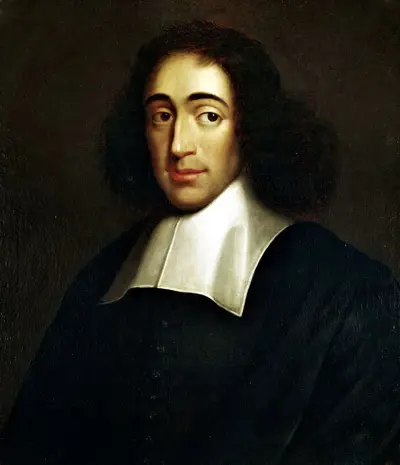
Baruch (de) Spinoza was a Dutch philosopher of Portuguese Sephardi origin. One of the early thinkers of the Enlightenment and modern biblical criticism, including modern conceptions of the self and the universe, he came to be considered one of the great rationalists of 17th-century philosophy. Inspired by the groundbreaking ideas of René Descartes, Spinoza became a leading philosophical figure of the Dutch Golden Age. Spinoza's given name, which means "Blessed", varies among different languages. In the Netherlands he used the Portuguese name Bento. In his Latin and Dutch works, he used Latin: Benedictus de Spinoza.
