Albert Einstein Quotes
I believe in Spinoza's God, who reveals himself in the harmony of all that exists, not in a God who concerns himself with the fate and the doings of mankind.
The original was in German. Spinoza was a Dutch Philosopher who originated this abstract notion of a universal God. This was one of the reasons fro his excommunication. Spinoza’s ideas were considered so radical and dangerous that he was the only man in history who was excommunicated by the Catholics, the Jews and the Muslims.
Albert Einstein, 1879-1955, Nobel laureate in Physics, Telegram to Rabbi Herbert S. Goldstein, Quoted in "Einstein believes in 'Spinoza's God”, the New York Times April 25, 1929
Sourced by: Eigen's Political and Historical Quotations

Scientists themselves contain religious believers as well as atheists and agnostics, While there are a number of scientists who argue against religion, there are many who do not and are believers. Albert Einstein, for example, was a believer in a universal God. See {631763}.

His concept of the devine however was quite different and much more abstract than the Rabbis, Priests and Imams of the time. Albert Einstein, was a religious Jew, but his view of God was that of Spinoza (See Quotation 631763) who had been excommunicated by the Jews. Spinoza’s ideas were considered so radical and dangerous that he was the only man in history who was excommunicated by the Catholics, the Jews and the Muslims. Spinoza did not believe in a kins of anthropromorphic God who fabricated the earth and the stars. He saw God in the devine nature of the earth and the heavens and the mathematical rules that govern everything. It was this abstraction that was Spinoza's God which made sense to Einstein. Got was in the order, physical laws and mathematics of the universe. Modern scientists who are religious have no difficulty with the probablsitic nature of much of the physics that governs the univrese. It was God who created or more abstractly, was the mathematical and physical laws that in turn allowed the universe to be created from nothing.


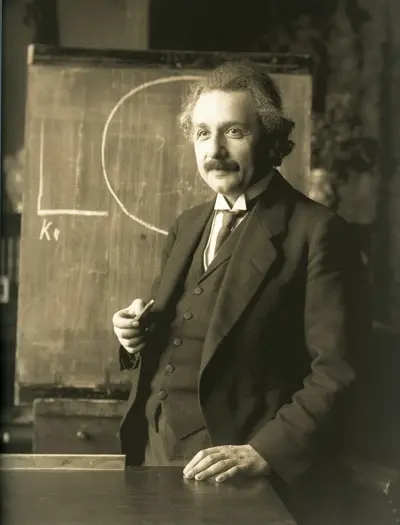
Albert Einstein was a German-born theoretical physicist, widely acknowledged to be one of the greatest physicists of all time. Einstein is known for developing the theory of relativity, but he also made important contributions to the development of the theory of quantum mechanics. Relativity and quantum mechanics are together the two pillars of modern physics. His mass–energy equivalence formula E = mc2, which arises from relativity theory, has been dubbed "the world's most famous equation". His work is also known for its influence on the philosophy of science. He received the 1921 Nobel Prize in Physics "for his services to theoretical physics, and especially for his discovery of the law of the photoelectric effect", a pivotal step in the development of quantum theory. His intellectual achievements and originality resulted in "Einstein" becoming synonymous with "genius".
