William Howard Taft Quotes
I am a Unitarian. I believe in God. I do not believe in the divinity of Christ, and there are many postulates of the orthodox creed to which I cannot subscribe.
A century later, it would be very difficult if not impossible for anyone with these religious beliefs to obtain the Republican Presidential Nomination, as the Republican Party was controlled by conservatives and fundamentalist and evangelical Christians. However, in 1899, the fundamentalist Christians were aligned with the Democratic Party, and they referred to the Republicans as “Godless Republicans”. Taft belonged to the Unitarian Church and did attend church unlike the later President Eisenhower. See {626401}.
William Howard Taft, 1857-1930, 27th President of the United States (Republican, OH), Chief Justice of the U. S. Supreme Court, Letter to Yale University (1899), Quoted in Henry F. Pringle, William Howard Taft: The Life and Times
Sourced by: Eigen's Political and Historical Quotations

Eisenhower did not go to church on Sundays. He was brought up in a Bible Reading, Christian Family. When he served under MacArthur in the Army, MacArthur often criticized him for not attending church. Eisenhower was the only President in American history who did not belong to any church at the time he was elected. He was not anti-religious at all and thought religion was a very important part of the American Way of life. He started Cabinet Meetings with a Silent Prayer, but he himself was not an observant Christian. In this sense he was very much like a number of our Founding Fathers, like Jefferson, Franklin and John Adams for example.

_0_PostageStamp_47x47.jpg "Chairman of the Joint Chiefs of Staff Navy Adm. Mike Mullen gives an interview to John Dickerson during the CBS news program Face the Nation in Washington, D.C., July 5, 2009. During the interview, Mullen discussed the wars in Iraq and Afghanistan, North Korea's recent missile tests and his recent visit to Russia. (DoD photo by Mass Communication Specialist 1st Class Chad J. McNeeley, U.S. Navy/Released)")

Also inscribed in gold around the Dome of the Rock. This was the most overt statement against Christianity and the Trinity in the Koran.


Early Christianity had a wide diversity of sect and opinion.
While moderate Muslims interpret this sura as meaning that theologically, a belief in the divinity of Christ is inconsistent to Islam, extreme fundamentalists take this to indicate that Christians are heretics and should be executed in accordance with Sharia – Islamic Law.


This oath was even in force after the American Constitution was ratified and in effect. At the time, the Bill of Rights was not believed to be binding on the States—only on the Federal Government. Throughout American history there were many practices that were unconstitutional but were simply never litigated in the courts. Local community pressure often inhibited individuals from asserting their rights in the Federal Courts as did the expense. So, for most of American history local communities forced stores to close on Sunday. When the issue was finally taken to the Supreme Court, it was clear that such a practice was in violation of the First Amendment. Even in 2011, in Atlanta, it is “illegal” to buy beer on Sunday. When someone decides to litigate that, it will likely also be declared unconstitutional. The law not only discriminates against non Christians, but there are a few Christian sects which believe that Saturday is the Sabbath.


Quintus Septimius Florens Tertullianus. Though first coined by Theophilus of Antioch in A.D. 180, Tertullian was the first to clearly explain what is now considered a fundamental Christian doctrine by most Christian Sects. The word itself or its concept never appears in the New Testament. It was not a part of early Christianity or of early CHristian theology.


Jefferson was a deist but had little love for the organized religions and did not consider the Bible as the revealed word of God.


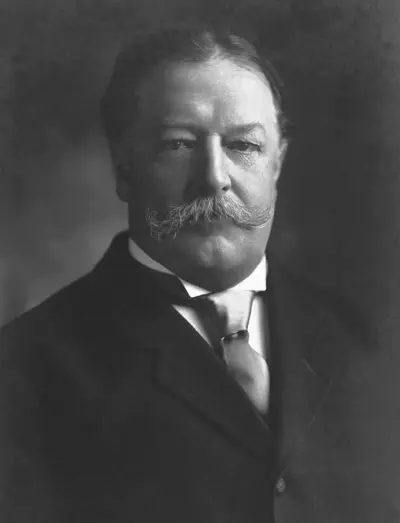
- Born: September 15, 1857
- Died: March 8, 1930
- Nationality: American
- Profession: President
William Howard Taft was the 27th president of the United States (1909–1913) and the tenth Chief Justice of the United States (1921–1930), the only person to have held both offices. Taft was elected president in 1908, the chosen successor of Theodore Roosevelt, but was defeated for reelection by Woodrow Wilson in 1912 after Roosevelt split the Republican vote by running as a third-party candidate. In 1921, President Warren G. Harding appointed Taft to be chief justice, a position he held until a month before his death.
