Dwight D. Eisenhower Quotes
When I was at West Point I had to go to church every Sunday, I am not going back to that.
Eisenhower did not go to church on Sundays. He was brought up in a Bible Reading, Christian Family. When he served under MacArthur in the Army, MacArthur often criticized him for not attending church. Eisenhower was the only President in American history who did not belong to any church at the time he was elected. He was not anti-religious at all and thought religion was a very important part of the American Way of life. He started Cabinet Meetings with a Silent Prayer, but he himself was not an observant Christian. In this sense he was very much like a number of our Founding Fathers, like Jefferson, Franklin and John Adams for example.
Dwight D. Eisenhower, 1890-1969, 34th President of the United States (Republican KS), Quoted on PBS The Charlie Rose Show, May 22, 2012
Sourced by: Eigen's Political and Historical Quotations

A century later, it would be very difficult if not impossible for anyone with these religious beliefs to obtain the Republican Presidential Nomination, as the Republican Party was controlled by conservatives and fundamentalist and evangelical Christians. However, in 1899, the fundamentalist Christians were aligned with the Democratic Party, and they referred to the Republicans as “Godless Republicans”. Taft belonged to the Unitarian Church and did attend church unlike the later President Eisenhower. See {626401}.


He was not asked to change his views, simply to remain silent, He refused as he felt that his silence would be dishonest. Ingersoll was considered to be the greatest orator and political thinker of his day, but his overt atheistic views curtailed his elected political career.


Kennedy was being hurt be fears that as a Catholic, he would be beholden to the Pope and the Catholic Bishops. There were many protestants who believed that the Catholic Church was antithetical to democracy and some who even believed that Catholicism was the religion of Satan. Kennedy decided to confront the issue head on.


As enlightened as this statement is, it was not always a part of Mormon doctrine. When Brigham Young was head of the church he also served as Governor of the Utah Territory, and the separation of church and state was not so clear. In modern times however, the Mormon views have been the quintessential views of most Americans—Mormon or otherwise.

In 1836, Sir Andrew Agnew introduced into the House of Commons the Sunday Observance Bill, by which almost all activities other than "works of piety, charity, or necessity" would be outlawed on Sunday. Writing under the name "Timothy Sparks," Charles Dickens noted that enforced Sunday observance would transform:


See John Leland for opposition to this clause: {608955}


Lopez and Elizer were Jews who had escaped the persecution in Portugal to come to America. They and other non-Christians could live and work in Rhode Island but could not vote or hold public office by a previous decision of the Rhode Island Assembly. See {619707}.The Jews had petitioned for their civil rights.


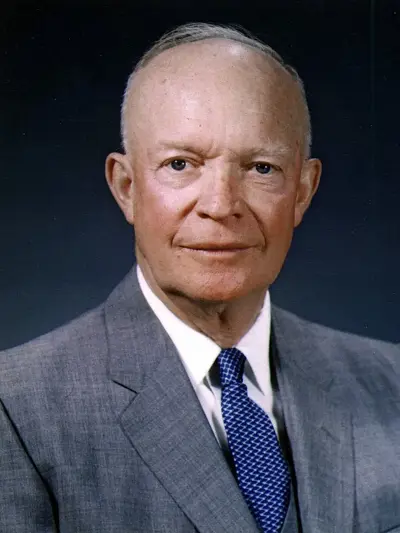
- Born: October 14, 1890
- Died: March 28, 1969
- Nationality: American
- Profession: President
Dwight David "Ike" Eisenhower GCB OM GCS CCLH KC NPk was an American military officer and statesman who served as the 34th president of the United States from 1953 to 1961. During World War II, he became a five-star general in the Army and served as Supreme Commander of the Allied Expeditionary Force in Europe. He was responsible for planning and supervising the invasion of North Africa in Operation Torch in 1942–43 and the successful invasion of Normandy in 1944–45 from the Western Front.
