James II Quotes
They will leave the King nothing other than the empty name of King, no more
James was then the Duke of York. James’ brother, Charles II, wore the crown and he later would be forced to flee to France by the Parliamentary forces . The Duke understated the degree to which the Parliamentary forces were prepared to go in the days which English historians call the English Interregnum.
James II, 1633-1701, King of England, Statement Referring to Parliament which was bent on Reform of the Monarchy
Sourced by: Eigen's Political and Historical Quotations

Windsor was the Kings palace and the King felt that was all he really controlled.


The issues of check and balances in the American constitution were radical by world standards of the day. However, it was by no means an new concept and as this quotation illustrates was discussed and debated in England, but although England was far ahead of almost all other countries with respect to eliminating absolute power, they never took it as far as the Americans did. That took a revolution.

Some of the Patriots of Early America realized that the oppressions of British rule were coming from Parliament and initially took the position that only the King could make laws for the colonies and not Parliament. Therefore, they were as Englishmen challenging illegal English laws. Most American hostility was directed at Parliament and not the King. However, once there was any physical resistance, King George came down with such a heavy hand that American hatred transferred to him. For related quotes on the King/Parliament issue, see {639145}, {639144}, {639143}, {639141}, {639140}, & {639137}


His immediate frustration was the title form of address first selected by Congress for the President. See {586767}


Knute the Great, King of Norway and England, was said to have attempted to control the tides by giving them Royal Commands. This was given by an early historian, Henry of Huntington, 1084-1155, as an example of the fallibility of kings as opposed to God.


See Jeremy Bentham for a later, but similar English view.

The king was right about the eventuality but wrong about his ability to keep his kingdom during his lifetime. The Arabs displaced him shortly thereafter. Mwanga was a notorious tyrant who constantly had his own people tortured and murdered. See Fredrick Holmwood.
Strong argued in petitioning a Connecticut court for divorce in 1788 that her husband’s abuse had removed her obligation to obey him

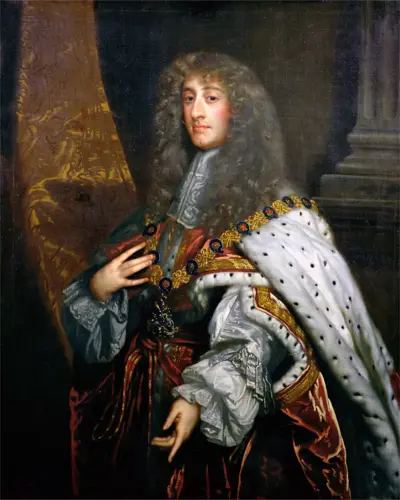
James II and VII was King of England and Ireland as James II, and King of Scotland as James VII, from 6 February 1685 until he was deposed in the Glorious Revolution of 1688. He was the last Catholic monarch of England, Scotland, and Ireland; his reign is now remembered primarily for struggles over religious tolerance. However, it also involved the principles of absolutism and divine right of kings, and his deposition ended a century of political and civil strife by confirming the primacy of Parliament over the Crown.
