Roger B. Taney Quotes
They (negroes) had for more than a century before the Declaration of Independence been regarded as beings of an inferior order, and altogether unfit to associate with the white race, either in social or political relations; and so far inferior that they had no rights which the white man was bound to respect; and that the negro might justly and lawfully be reduced to slavery for his benefit. He was bought and sold and treated as an ordinary article of merchandise and traffic whenever a profit could be made by it.
Roger B. Taney, 1777-1864, Chief Justice of the U. S. Supreme Court, U. S. Treasury Secretary, Dred Scott v. Sanford, 1857
Sourced by: Eigen's Political and Historical Quotations

Newsletter of the United Sons of Confederate Veterans

His solution was not to change the prejudice or improve the opportunity for Blacks but to have complete separation of the races. See {625687}.

It was indeed the first government that was ever founded on that fallacious principle. In retrospect, it was amazing that more Southerners did not question why no other government in the history of the world based a society on that principle. The Southern hubris was a great failing for them.


Charleston was in the Southern part of the state where most people supported slavery. Douglas made an unequivocal pitch for the racist vote {600060} and forced Lincoln to take a stand. Like many politicians today, Lincoln decided to give the audience what they wanted to hear. It is not clear whether or not he ever believed this statement or was just pandering in a political campaign. He had never said this in the Northern part of the state of before. Lincoln’s views on race changed and matured over the years, culminating in the Emancipation Proclamation. Lincoln lost the Senate seat to Douglas.


The Boers were generally furious because the British emancipated the Blacks that the Boers were holding as slaves. This hurt their economic interests. But according to this woman in the middle of it all, the worst of it was the insult of giving the Blacks political and functional equality. This was really very similar to most American Southern racist feeling during Reconstruction. Racism is very pernicious, in that the remedies always bring about insult and anger because the belief structure of slavery and discrimination must be based in a theory of inferiority.


As a British Loyalist officer, he and his men were dispatched to Savannah, Georgia. There he saw the Southern version of slavery for the first time and was shocked at the cruelty. At the end of the Revolutionary war, he and many other loyalists fled to Canada and began his political career, then representing Britain in the Caribbean. See also {591379}.

Contrast this view with that of Union General Ulysses S. Grant.

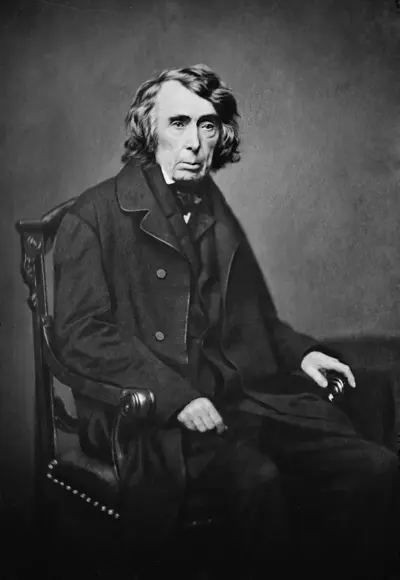
Roger Brooke Taney was the fifth Chief Justice of the United States, holding that office from 1836 until his death in 1864. He delivered the majority opinion in Dred Scott v. Sandford (1856), ruling that African Americans could not be considered citizens and that Congress could not prohibit slavery in the territories of the United States. Prior to joining the Supreme Court, Taney served as the United States Attorney General and United States Secretary of the Treasury under President Andrew Jackson.
