William Lloyd Garrison Quotes
These are solemn times. It is not a struggle for national salvation; for the nation, as such, seems doomed beyond recovery. The reason why the South rules, and the North falls prostrate in servile terror, is simply this: With the South, the preservation of Slavery is paramount to all other considerations--above party success, denominational unity, pecuniary interest, legal integrity, and constitutional obligation. With the North, the preservation of the Union is placed above all other things--above honor, justice, freedom, integrity of soul, the Decalogue and the Golden Rule--the Infinite God himself. All these she is ready to discard for the Union.
Garrison and some of the other radical abolitionists actually argued for dissolution of the Union as a means to end slavery. These abolitionists were convinced that if the United States split in two, slavery would end. See {613764} & {613626} for a description of the logic.
William Lloyd Garrison, 1805-1879, Editor & Abolitionist, 1854
Sourced by: Eigen's Political and Historical Quotations

The Reference to St. Domingo refers to the slave rebellion in Haiti, the first major, and successful slave revolt in the Western Hemisphere. The revolution was characterized by the revenge taken against the former slave masters. Thomas Jefferson, then the President, refused to recognize the new government and actually boycotted it. He and most Americans at the time were fearful that a slave revolt in the U. S. would produce revenge attacks against former masters, and indeed the national government supported the slave owners in subjugating all attempted armed rebellion. This reached its zenith in the Federal troops putting down the John Brown attempted revolt at Harpers Ferry. Instead of the bloodshed of a slave revolt, America experienced the bloodshed of a Civil War.


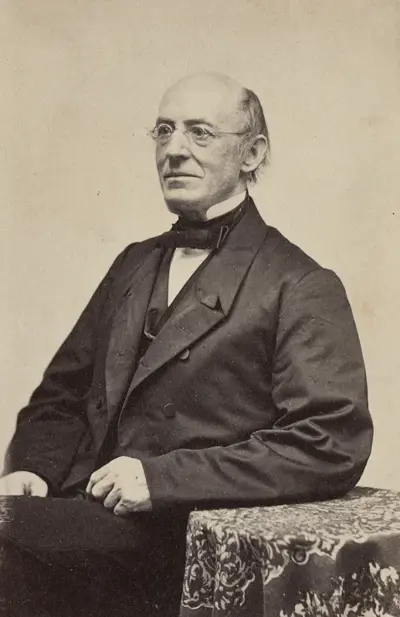
William Lloyd Garrison, who signed and printed his name Wm. Lloyd Garrison, was a prominent American abolitionist, journalist, suffragist, and social reformer. He is best known for his widely-read anti-slavery newspaper The Liberator, which he founded in 1831 and published in Boston until slavery in the United States was abolished by Constitutional amendment in 1865. He was one of the founders of the American Anti-Slavery Society, and promoted immediate and uncompensated, as opposed to gradual and compensated, emancipation of slaves in the United States.
