Ron Paul Quotes
There's a a right to privacy for all individuals and all who have legal rights - and that includes the unborn. As an obstetrician, if I cause any harm to a fetus, I will be sued. If someone kills or harms a fetus they're liable in a court of law.

First female presidential candidate & first divorcee to run for that office. This quotation is quite remarkable for several reasons. Woodhull was far ahead of not only her time but the other feminists and suffragettes at the time in demanding equal right for all women in all thinks including free love. She was generally viewed as an amoral radical. Yet on this critical issue, the was an opponent of abortion and one of the first people to ever claim that a fetus had rights.
While most people at the time opposed abortion, it was based on religious doctrine. Woodhull based her opposition on an equal rights argument—perhaps the first American to do so. Note, that like other feminist leaders of the time, she opposed abortion. However, between the economic pressures and the illegality of birth control devices and information provision, abortion was a critical decision that had to be faced by many women. Later, feminist leadership had to come to grips with the issue of who makes the decision in these areas, and placed the right of the woman to make these decisions, as opposed to husbands, fathers and government, as the highest priority. Then, when the drivers for abortion could not be eliminated, it was women who were criminalized. Feminists then fought for the right of abortion and the right of the woman to make decisions, but feminine leadership has never—in America—been advocates of abortion as opposed to the right of abortion, a subtlety that often is lost.


Prosecutors, even ones who are frequent lawbreakers themselves violating defendant's rights or illegally manipulating trials, are reluctant to be officially found to have done so. Many politicians start their political careers as prosecutors and then rise to higher office. If it is officially found that they had abused a defendant and violated the law, it can be detrimental to their careers. So in many states, they have placed barriers making it much harder for an improperly convicted person to even get a court hearing. The cost to society however is that they are never accountable, and people have been wrongly imprisoned and cannot even get a hearing to prove that they were the victims of official misconduct. The rationale for these rules that prevent victims from obtaining fairness and justice is finality—the concept that there should be some end to the process of appeals so justice can be said to have been done. It prevents a kind of closure for many of the victims of crimes and their families if the guilty perpetrator is constantly appealing or can do so.

See {587703} for a similar statement by a Supreme Court Justice.


One of the major motivations for abortion at that time in both England and the United States is the terrible stigma which a child born out of wedlock faced together with the mother. When the stigma of so called “illegitimate children” began to diminish, one of the causes of abortion weakened. Note, that like other feminist leaders of the time, she opposed abortion. However, between the economic pressures and the illegality of birth control devices and information provision, abortion was a critical decision that had to be faced by many women. Later, feminist leadership had to come to grips with the issue of who makes the decision in these areas, and placed the right of the woman to make these decisions, as opposed to husbands, fathers and government, as the highest priority. Then, when the drivers for abortion could not be eliminated, it was women who were criminalized. Feminists then fought for the right of abortion and the right of the woman to make decisions, but feminine leadership has never—in America—been advocates of abortion as opposed to the right of abortion, a subtlety that often is lost.


Many New Yorkers and others felt that since the attack on the World Trade Center was made in the name of Islam, the mosque and commuity center should be built in another location further from Ground Zero. Ellison was debating someone who argued that the Mosque should not be built so that sensitivity can be shown for those New Yorkers who lost relatives and friends in the attack of September 11. Rather than insist on their Constitutional rights, the Muslim leadership of the project, moved the location somewhat further away from Ground Zero.


If a state or community legally decides that a fetus is a person, there are many situations where there is a conflict of interest between the mother to be and the fetus. A pregnant woman, having a single drink of alcohol, potentially dangers the fetus (called Fetal Alcohol Syndrome). Smoking is clearly hazardous to the health of the fetus (underweight babies and more infant mortality and even more SIDS deaths. A diet to keep a mother thinner may not be nutritious for the fetus, A few states and local government have started prosecuting pregnant women for their personal behavior that might be detrimental to the fetus—often the purpose is to assert the right of the state to regulate the behavior of the pregnant woman so that the state can control abortion.


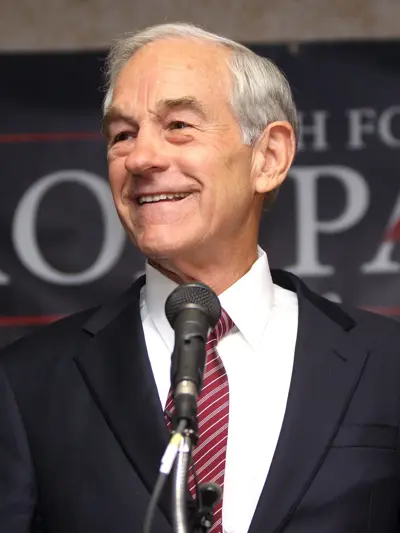
Ronald Ernest Paul is an American author, physician, and retired politician who served as the U.S. Representative for Texas's 22nd congressional district from 1976 to 1977 and again from 1979 to 1985, and for Texas's 14th congressional district from 1997 to 2013. On three occasions, he sought the presidency of the United States: as the Libertarian Party nominee in 1988 and as a candidate for the Republican Party in 2008 and 2012. A self-described constitutionalist, Paul is a critic of the federal government's fiscal policies, especially the existence of the Federal Reserve and the tax policy, as well as the military–industrial complex, the war on drugs, and the war on terror. He has also been a vocal critic of mass surveillance policies such as the USA PATRIOT Act and the NSA surveillance programs. He was the first chairman of the conservative PAC Citizens for a Sound Economy, a free-market group focused on limited government, and has been characterized as the "intellectual godfather" of the Tea Party movement, a fiscally conservative political movement that is largely against most matters of interventionism.
